Wednesday, May 06, 2015

Afghan Creative Arts Prison Project - First Report

In April Joanna and Anna spent a month in Herat launching the Creative Arts Prison Project. We are working again with members of Simorgh Theatre, with whom we collaborated for the Theatre for Social Development project in 2011. Here is Anna’s first report.

Together again!
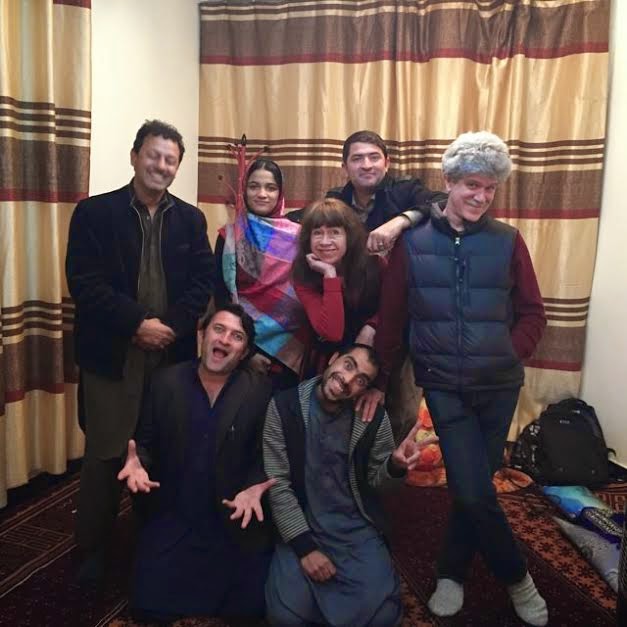
Back in Afghanistan after four years. Back to Herat to see the girls of Simorgh again! How wonderful to have the chance to work together again. Four years is a long time, and yet it’s like yesterday. But going from 13 to 17 or 16 to 20 makes a big difference. They’re young women now, all grown up. I hardly recognized some of them! And others look exactly the same. (For me, I just look older, as one of them pointed out. Well, yes, time does that!). We had a happy reunion and then we met the new girls who have joined the group. All in all, we are working with six young women, and then two young men who are helping out -- who really just want to be part of the process, and I’m so glad to see them again too! They are great guys. But this project is specifically for women by women.

Getting ready for action
All of us jumped headlong into our work together with great excitement and energy. For the first nine days we did training to prepare the group for the upcoming program. Workshops practicing various theatrical exercises in the morning, and in the afternoon rehearsals to develop a performance. In between we have lunch together. During the week I think to myself, “We are having such a wonderful and fulfilling time together that if this is all we do with the project I will be happy!”

Enjoying lunch together the Afghan way. 
But we have much more to accomplish. The goal of our project is to bring theater workshops to the women’s prison and the juvenile correction center as a way to offer psychosocial support -- to give the women and girls a safe, creative forum in which to express themselves and process their experiences through play and physical action. Research and experience has shown theater to be an effective tool in helping people heal trauma, build self-confidence and manage daily challenges. Eventually the women will have the opportunity to create their own plays. The aim is for this to be an ongoing program throughout the year.

We are training the members of Simorgh Theatre to lead the program and teach the workshops, as we are only here for a month and after we leave, the project will continue. We are also preparing a play that we will present first thing as an introduction to theater. That is, the Simorgh girls will present it. Joanna and I are directing and they perform. Many in Afghanistan have never seen a live theater performance and have no idea what it is. We want to show them that they can create a play just like this with their own stories.

A Common Problem
The play is called The Backbiters and centers on two gossiping women who make life difficult for a young woman, Nafisa, who wants to go to university. They talk bad about her and spread rumors that worry her family. Nafisa’s friend, a younger girl of thirteen named Fereshta, looks up to her and dreams of herself becoming a doctor one day. But Fereshta’s father has other ideas. He has decided she’s going to get married to an older, rich man who will give the father lots of money. Fereshta is devastated. The mother can do nothing to prevent it, but finds an ally in Nafisa’s mother and together they speak to the mullah (similar to parish priest). This mullah is a wise, learned man who talks to the father about the laws of Islam and that a girl must agree to who she marries and that Fereshta is much too young and should get an education. He points out what happened last year when the neighbor’s wife almost died because they couldn't find a female doctor to treat her. It’s good that girls study to become doctors! The father struggles with the idea but finally decides to forego the marriage and let his daughter study. Meanwhile, the backbiters have had some backlash and decide they must mend their ways.

Our story has a happy ending, but unfortunately this is not the case for many girls in Afghanistan. This is a common scenario – forced early marriage. Even though Islam does say a woman must agree to marriage and should be educated, many villages follow old tribal ways that have become tradition and conflated with Muslim practice. The community listens to the mullahs who often are corrupt or ignorant. And people are very concerned with what the community thinks and says about them because honor is everything. Gossiping old ladies is a common problem and families can be destroyed by bad rumors.

Our talented actors in Simorgh made the play very compelling and also added lots of humor to it. The two women playing the backbiters were funny and forceful, and the woman playing the father (yes, women only-troupe playing all characters) didn’t hold back in her portrayal of a gross, old man. It’s exaggerated but all too real.

Joanna guides a discussion planning for our workshops in the prison. 
Showtime in the Prison
The day arrived for us to present our play at the women’s prison! I wasn’t sure what to expect, or how the women would take to the show or the idea of doing workshops.  How open and accessible will they be, or perhaps closed off, resistant, even hostile? No telling what will happen, we’re breaking new ground. Here we go – "hala hamagi hamabaham bedboard!" ("Now everybody all together, let’s go!")

Well, it went fantastically well. About ninety women in all gathered to see the performance. They laughed and applauded and listened intently, and a few cried. Afterwards we did a talkback where they had a chance to speak about the show and go up on stage and engage with the characters. This is where I wasn't sure how it would work. But it worked very well. The women didn’t hesitate to engage. Some stood up and talked about their own personal circumstances. Others got up on stage to confront characters, especially the father. They argued with the father for not letting his daughter go to school and marrying her off so young. The woman playing the father stood her ground and said “Everyone in my family married before the age of 13, it’s no problem.” The prisoner countered, “And this is why we’re all in here!” Spontaneous applause broke out in acknowledgement. Another woman wanted to speak with the mullah and proceeded to rail against mullahs who are bad and want money and don’t follow proper Islam. She was animated and passionate in her speaking. All the women spoke with great passion. It was clear the play really resonated with them. It reflected and acknowledged their situation and gave them a chance to have a voice and speak out.

Afterwards, several women came up to me and exclaimed over and over again, “I’m so happy, I’m so happy, thank you for being here, thank you for presenting this play to us.” One woman seemed particularly taken and keen to connect. She asked my name and where I was from, I said USA and Sweden, and then she wanted to know which I liked better, Afghanistan or Sweden. I told her they are very different, and that I really like the people of Afghanistan -- they are so friendly and hospitable. She said, “We are friendly because you are. We respond to you. You are so nice and friendly, and we want to be friendly back.” At the end, she took a ring off her finger (a crocheted band with black beads) and put it on mine and told me, “This is a memory from me.”

I wonder what happened to her, what she did that she is here in prison. Did she run away from home? With her lover? From a threatened forced marriage? Or was she forced into marriage? And did she run away from an abusive husband? Was she raped? Did she kill somebody? These are many of the possible scenarios and circumstances that land a woman in prison in Afghanistan. I did not want to ask this woman right away, but Joanna and I have heard many stories since that first day.

More to follow! 

No photos beyond the barbed wire!

Wednesday, March 25, 2015

Jessy's Experience Teaching Theatre at Kakamega School for the Deaf

Jessy tells us her thoughts about her recent experience leading theatre workshops with deaf students in Kakamega, Kenya.  
 
Today, I led a one-hour workshop with a group of sixty deaf students at Kakamega School for the Deaf. Ages ranged from 7 to 17.  All of the students participated in the first three activities, and only classes 4 through 8 participated in the second half. This was largely due to the fact that their sign language was more fluent (some deaf Kenyans don't learn sign language until 9 or 10 years of age). 

I had some time to speak with the head teacher of the school.  He told me that some of these children are orphans, some have wandered in off of the streets, and others are abandoned by their families.  Any kind of disability is seen in Kenya as a curse, and families often want to rid themselves of the child in fear that the curse will directly affect them.  

Of course, I had a person sign as I spoke.  This was an interesting experience - and also a real "performance" in itself.  Sign language is such an expressive form of communication.  It includes facial expression, body movements, and even the occasional sound or squeal. 

Awooga!
They liked this activity, but they obviously didn't know that they were supposed to shout "Awooga!" They still jumped, but I realized how helpful the sound itself is in coordinating the jump of the two people. 

Passing Energy in a Circle
The students had some difficulty with this one.  Making eye contact with the person to whom they would like to throw the energy proved difficult.  This may have been due to the fact that the group was large, or maybe they have difficulty focusing their attention on one area of the room just in case something else happens around them that they need to react to.  I'm not entirely sure.  They were also trying to keep their eyes on the interpreter at all times just in case he gave them further direction.  Because of this, we ended up just passing the energy around the circle one at a time instead of throwing it across.  It still worked, and they still seemed to really enjoy it.  

I think it is important to note that deaf students have to keep their eyes set on the interpreter at all times in order to know what is happening.  This would make activities such as Walking Through Space (pg. 26), Trust Walks (34), and Group Start, Stop, and Jump (pg. 38) particularly challenging.

Follow the Leader 
Students, especially those who are ousted from society due to their disability, have a deep desire to please.  Creativity plays no true role in their education system.  This is in part due to Kenyan culture and in part because they are so far behind in their schooling to begin with.  Because of this, they often try to copy what the teacher does.  Therefore, after I demonstrated the activity with my interpreter, they used my movements exclusively and did not add any of their own.  

I have experienced this to some degree in the past, especially in societies that use rote learning styles, and I think that it is something interesting to note - demonstration can sometimes hinder students' ability to think on their own.   

Following these three exercises, I asked each class group (class 4 to class 8) to pick a story of struggle from their lives and present it as a drama/mime for the younger students.  It was interesting that all of the scenes began with characters greeting one another with handshakes.  Handshakes are very important in Kenyan culture, and forgetting to shake someone's hand can be considered very rude. 

I think it could be great to include some kind of disability section in the manual.  It would be great to identify which activities in the manual lend themselves most to deaf individuals, blind individuals, physically challenged individuals, etc.  This would be another way to make the manual truly accessible to all groups.


Saturday, February 21, 2015

Story update - Youth from Kunar and Balkh provinces

Good to be back in the US for a minute.  Here's the latest:

We have been conducting workshops for youth in the provinces over the last month focusing on volunteerism and community improvement.  Then we bring youth groups from two disparate provinces to our facility in Kabul for an intensive week of working together.  We will do this with 25 provinces across Afghanistan over the next two years.  

In Kabul, with the two groups, we work on building presentation skills, developing viable Action Plans to address their chosen community issues, and writing proposals so they can get matching funds for the small "seed grants" that we give them. 

This past week, we brought together groups from Kunar and Balkh provinces.  Kunar is a very rural, extremely conservative Pashtun province on the Pakistan border.  Balkh is more a progressive northern province with Tajik, Uzbek and Hazara tribes.  Our point was to bring the youth from these diverse communities together to explore commonalities, discuss differences, and find unity in their goals of imagining and creating the New Afghanistan.  This is where our great theory of peaceful collaboration bumps into reality. 

To accommodate the conservative Kunar group, we conducted separate workshops for the females, which would have been fine, but the Balkh girls, being more urban and sophisticated, wanted to work with the guys as a team.  All the Kunar girls were here with their brothers (otherwise they would not have be able to travel) and were completely under their control.  We had many a long talk with the brothers about why their sisters couldn't do even the most simple, safe exercise with the men, even while staying completely covered.  The answer was that, if word got back to their village that their sisters had been face to face with strange men, it would be seriously dangerous for the entire family.  And who would bring back this information?  The other guys from Kunar, even though they are their friends!  The honor of the entire family rests on the woman's shoulders, and it seems no one outside the family unit can be trusted.  On the bright side, the women themselves were strong, well-spoken and brave.  I was more impressed with their calm and clear presentations than the men's.  It is a tragedy that these brilliant young women cannot make a single decision for themselves.... yet. 

Here is an interesting example:  On the first day, the groups presented their "community profiles".  The Kunar men made a fine presentation about how trees in Kunar are being cut down at an alarming rate which is leading to soil erosion and polluting the rivers.  The Kunar women did a presentation about violence against women with shocking visuals of women with ears cut off, noses cut off, beaten badly... and also spoke about how women are blamed for crimes they haven't committed and often traded to pay off debts.  Later, in speaking directly with the brothers of the Kunar girls, I asked why their project isn't about violence against the women and the women's project about the environment?  Which is more important to you, I asked, cutting a woman or cutting a tree?  Isn't a woman more valuable than a tree?  They actually were taken aback; I don't think they ever thought of it that way.  And now they are working on both issues together!  After that discussion, the Kunar men began presenting about violence against women... and the environment too.  Success!... a small one but mighty! 

Now both groups have returned to their provinces, and we will be monitoring their progress over the next month.  We feature theatre,  photography, mural painting, radio plays, poetry and music in our training as great ways for them to bring their issues to the wider community.  Communication... this is where the arts excel!  However, you can see the limitations of how, where, when and with whom they can present their art.

Our Afghan Training Team
Next we go to Parwan and Kandahar, two other diverse provinces, and then bring these groups together in Kabul for another intensive session.  Over the next two years, we’ll reach all of the provinces… inshallah.

Tuesday, February 17, 2015

First Impressions of Afghanistan and the Creativity in Action Program

Heddy Lahmann-Rosen, a Bond Street company member, just returned from her first visit to Afghanistan with Michael and Joanna for our new, two-year Creativity in Action program. Heddy will visit Afghanistan a handful of times during the course of the program, acting as our Outside Evaluator, and eventually using this research in her PhD thesis. 


I'm a little late to the party on getting a blog entry going for my time with the Creativity in Action program in Afghanistan, but I'll do my best to give a flavor of the whole experience. 

I embarked upon the adventure to Kabul with Michael and Joanna in mid-January, and I stayed for 2 weeks. Joanna and Michael are still there working away at building this program and making sure it's got the wings to keep flying when they come back.

My first week primarily consisted of a good amount of administrative work and preparation for this big and ambitious program. This baby is no small feat! The Creativity in Action program is 2-year youth development project that includes 15 young people from each of 25 provinces across Afghanistan (375 youth in all!). The program is providing jobs for local Afghan artists to work with youth– teaching them about expressing themselves and accessing their creativity, and then mentoring them and supporting them as they create and implement improvement projects in their own communities. If you can't tell, I'm pretty excited about it. So excited in fact that I'm centering my (eventual) dissertation around this phenomenal program!

So what's Kabul like? That’s kind of a tough question to answer, because I didn't really see so much of the outside world except through the car window. What did I see out the window? Well, Kabul is less conservative than other parts of the country. Some women wear burqa’s, although there are very few women on the streets anyway. I’d say it’s like 90% men. Unpaved roads for the most part. The air outside smells smoky from the ovens they use to warm homes. It’s winter and pretty cold – ranging from around 35 degrees F to 50. The heating isn't what we’re used to in the US, so lots of layers are necessary. It even snowed a few days while I was there!

The driving in Kabul is really something. It’s positively fearless (except for a Western passenger like me) – I mean, we navigated through the most insane tangle of cars on the way home one night– I thought we might be in serious trouble and stuck there for awhile (because if we were in the US, we would have) – but somehow our driver just wriggled, honked, and near-missed his way through. It was something to behold. 

The food is awesome! Maybe with the exception of breakfast, but that’s just because they don’t really do breakfast like we do. But everything else was AMAZING. Flower street, which had several florists up and down the street, was very pretty! Butcher street is not so pretty, as you might imagine.

The Afghan people I had the opportunity to meet are lovely. Very kind and warm. I met and spent some time with the Afghan artists who are/will be leading the youth workshops and are long time friends and creative partners of BST. They were all so eager to share their thoughts and experiences with such openness and enthusiasm. It was a major highlight!

I also had the opportunity to see some of the youth workshops in action in the Balkh region. I had such a wonderful time  meeting and getting to know the youth participating. They're a very inspirational group. They were incredibly warm and welcoming and had many questions about my doctoral program and my experience of being in their country. They are all very concerned and passionate about the state of their community and country and are eager to talk about the problems they see and ideas for ways to go about addressing them. I was pretty floored by how engaged they were with the whole process from the get-go. After I left, the youths from Balkh and Kunar met in Kabul for a combined workshop. This program provides a unique opportunity for connecting young passionate problem-solvers from across the country and across ethnic divides. It's killing me to have missed the Kabul workshop! But alas, my spring semester classes beckoned me back. I've been living vicariously through email updates from Joanna on the collective workshop with the 2 groups in Kabul- I will let her tell it- from what I read, the experience is something truly special.

I'm already looking forward to my return!


Friday, February 13, 2015

Another Workshop Update from Kenya

During this workshop, for adults from ten different tribes in Kenya, Jessy Hodder facilitated 11 different activities from our Theatre for Social Development Training Manual. Keep reading to learn the participants' favorite activities and Jessy's thoughts on this experience! 

I facilitated a workshop today (3 hours) for 33 Kenyan adults (20 women and 13 men).  The youngest was 24, the oldest was 41, and the average age was 29.  They originated from 10 different tribes.  I originally thought this might create a little friction, but they seemed to work very well together.  They were not at all shy.  Most of them had great self-confidence, and they all wanted to be involved in the activities.  I was pleasantly surprised!  


Passing Energy 
Sports, especially those involving balls, are very popular in Kenya.  While they enjoyed throwing the ball of energy, I found they especially loved kicking the ball of energy around like a soccer ball.  I think this really underlines their love for soccer here.  Soccer is one of the top pastimes in Kenya.

The Wind Blows for . . . 
It took a few tries for them to understand the point of the game, but once they got it, they had a blast.  They told me afterwards that they want to use this activity in their own communities to get to know their people better.  However, I did find it interesting that if a man and a woman had to fight for a seat, the woman would generally allow the man to take it.  This meant that a lot of women ended up in the center of the circle!

The Prop Game 
They were very creative with the items that I put in front of them.  I introduced each item as "magic" - when a person touches the "magic" object, it takes on a new function/ it turns into something else.  A water bottle transformed into everything from a shoe polisher to a cell phone.  They were also very keen to move around and get down on the floor for their mimes.  However, the idea of "magic" in Kenya is an interesting one, particularly because of the history of shamans and witch doctors.  Magic, in many ways, is very real to people here, and they see it as a powerful force.  I think this might be something interesting to consider. 

Group Stop, Start, and Jump
The group listened SO intently, and they were very concentrated on getting it right.  They didn't want to stand out or let the group down.  Again - group mentality.  

Machines with a Theme
It was clear that some of their movements and sounds emulated parts of machines that can be found in town - drilling machines, generators, welding machines, and maize grinders.  

Secret Friends and Enemies 
Since I was shut down last time when I mentioned the idea of "enemy," I asked the adults to decide what we should call the "friend" and the "enemy."  They decided on "angel" and "disease"/ "death."  I thought this was an interesting choice, as death is something very common here.  It is a reality.  It is something much easier for them to talk about and confront than the idea of an "enemy."  

Awooga! 
This was a great activity to get them moving after lunch when they seemed a little sluggish.  Because of their skirts, it was a little difficult for some of the women to do a star jump.  They still gave it a good college try!

Making Group Shapes and Scenes 
The way they made a sofa set with their bodies was identical to the way in which the female survivors formed theirs in my last workshop.  I thought this was very interesting and may suggest similar perspectives between the groups.

Trust Walks 
When I asked the participants to pair up with someone, they chose partners of all types: men were with men; women were with women; and men were with women.  I was surprised to see some males pair with females.  I made the space in which they could walk smaller and smaller, until it became very difficult to steer clear of other leader/follower teams.  It made them giggle when they bumped into someone, but it caused the leaders to focus even more on keeping their follower safe.  

Snowballs 
As it was a bigger group, and our circle was very large, I asked them to throw their snowballs into the center and scramble to pick up a different one from the pile. We didn't have enough time to write out full stories, so I just had them write words or phrases that they could act out for the group.  The two categories which I felt were most successful were animals and objects.  One by one, as they felt led, participants would enter the circle and act them out.  All of the animals were those which you often see in our village (chickens, cows, goats, dogs, etc.), and the objects were all things that you could find on a village homestead (tree, gas stove, etc.)

Creating Puppets out of Found Objects 
They worked in four groups, each of which produced one or two puppets.  Materials included paper, cardboard, small boxes, toilet paper rolls, plastic grocery bags, trash bags, egg cartons, tape, scissors, and pens.  These are all objects that can easily be found on the streets.  They worked very well together, and they remained engrossed in the activity for at least 30 minutes.  When asked to use their puppets to create a small play, I found it interesting that the representatives from each group (puppeteers) were all male.  The plays all had moral significance and referenced God.


When asked which activities they enjoyed most, they identified the following:
1.  The Wind Blows for . . .
2.  Snowballs
3.  Machines with a Theme
4.  Passing Energy in a Circle
5.  Trust Walks

All in all, I was reminded that people draw upon what they know.  They do not often think outside of their immediate experience.  I think this is a good thing to remember when being creative so that we can find ways of helping participants think outside of the box.
  

Thursday, February 12, 2015

Youth from across Afghanistan collaborate in Kabul

Joanna keep us up-to-date about the goings-on in Kabul. Afghan Project Leaders have completed workshops in Balkh and Kunar, and now youth from both groups are in Kabul together for a week of workshops, training, and idea-sharing.
Joanna Reports:

This morning the participants were all happily doing warm-ups and exercises. Now they are creating their "community mapping" (drawing their region) and then their "ideal communities" (as mixed Kunar-Balkh groups, hopefully sharing their ideas about what makes an "ideal" community).  

The sounds of laughter fill the house as it should be.  

They did their "community profiles" last night.  Very interesting -- each presentation was really really well done!  The issues that rise to the top are environment, medical, and women's rights.  The Balkh girls were all about pre-marriage testing to prevent certain diseases, and the need for vaccinations.  Both the Balkh and Kunar guys were most concerned by the wanton cutting of trees, soil erosion and proliferation of trash.  And the Kunar girls showed some shocking photos of the violence against women, including trading girls for bad debts, and blaming women for the crimes of others.  Unbelievable!  

We worked with the girls all together this morning and the Kunar girls are ready to speak out... but still cover up the second a male or a camera is anywhere close.  Three are daughters of other active women, and the other two need some gentle coaxing... but that's okay.  They will all help each other I hope.  

And then, two days later…

The workshops are continuing well! It is super-busy and also super-fun.  

We have had some great guests speaking about youth activism, how to meet challenges, how to get the government to listen, etc.  And today we went to the Presidential Palace!  It was grand... and an amazing experience for the youth -- like a trip to the White House to meet ... well, okay, not Obama... but maybe Joe Biden.  


We had a two-hour session with one of the top people during which the participants stood up and talked about their issues. Wow.  Can you imagine getting a chance to air all your grievances with some top government person who is actually listening and writing it all down. Even the Kunar girls all covered up stood up and gave their rant.  The guy was very moved, and then he told us that he had also had this idea to set up creative youth projects in different provinces, then bringing the groups together and implementing the projects.  So he was very happy that we were doing just that.  

This Balkh-Kunar collaboration is the first of many in the coming years. Groups from across Afghanistan will come to Kabul and share ideas with group members from a different province, each with their own issues, solutions, history, and culture. Stay posted for more updates from the field! 

Wednesday, January 28, 2015

Theatre for Social Change Successes and Challenges from Kakamega, Kenya

Our Fall 2014 intern, Jessy Hodder, is spending the semester in Kakamega, Kenya where she is conducting physical theatre workshops with various groups, from sex workers to street boys. She has been testing out our new theatre for Social Development manual. Here, she describes some of the challenges and successes of a recent training session with sex workers.

I had a very positive meeting this morning with Kakamega's sex workers.  

The first thing that I should note is that, like many places around the world, things are far more challenging than you expect them to be.  Things don't start on time, and the people are not used to open, unstructured spaces.  It took the women some time to get comfortable in a space without desks and chairs.  Having a translator also presented some real challenges.  I was never sure if what I was explaining was being fully understood by all participants.  Things can so easily get lost in translation.  I think that it may be helpful to include notes concerning these kinds of logistics (tips or tricks to help facilitators overcome such difficulties) within the manual. 

Below is a list of the activities that I facilitated and some of the observations that I made.


Spy:  Secret Friends & Enemies

At the beginning of this exercise, the women protested profusely.  They hated the idea that they had to select an "enemy" in the group.  I tried to explain that it was just for the sake of the activity, but they wouldn't have it.  So we changed it to person A and person B:  "Keep person A between you and person B."  I thought this was interesting.  It definitely reinforces the sense of community that is so ingrained here, and indeed the sisterhood of those who suffer on the streets.

Also, the fact that Kenyan women are such touchy-feely people posed a problem.  When I said "go," the women ran to the person that they had chosen as their "friend" (person A) and just stood there hugging them and laughing.  They had completely forgotten about the "enemy" (person B).  They were so loving and supportive that they got caught up in cuddles and disregarded the activity itself.  Because of this, we may want to suggest that, in certain cultural contexts, participants can never touch their friend OR enemy, ensuring that some kind of physical activity takes place.


Calling Over the Mountain 

I explained the importance of our names, especially in contexts where we feel treated like objects.  The women had absolutely no difficulty shouting their names.  They were very loud, and they loved it!  

I added a little something extra to this activity which I thought worked well.  I asked them to imagine that they were standing on a stage in front of the world.  I asked what they would want to say if they were given a single sentence.  They were all eager to share.  Some of them declared their strength or beauty, others testified to their faith or beliefs, and others shouted funny exclamations.  The voices of these women are not often heard, and they loved being able to speak loudly and with conviction. 


Making Group Shapes and Scenes . . . with a Time Limit!

Participants worked in groups of five.  I focused on items that they are very familiar with - the jiko (outdoor stove), nyumbani (house), matatu (bus), and a sofa set.  They really enjoyed using their bodies to represent these items, and they worked well in their teams.  However, because of the stigma against trousers here, the women struggled a little bit with moving around in their long skirts.  I know that this is a challenge in many different areas of the world, but it was definitely something that affected their movement.


A Commercial - Selling Something New

This activity was particularly interesting to me.  I will begin by saying that Kenyans are wonderful public speakers - they have little or no fear of addressing a group.  In fact, they love doing it whenever they get the chance. 

I had tried very hard to explain the word "invention" - an object that doesn't yet exist that would make one's life easier or better.  However, either the word got botched in translation, or the culture is such that they don't think in terms of new objects and gadgets.  Technology is not nearly as prominent here as it is in other places.  Their mindsets are also extremely practical, and they are desperate to make any money that they can to support their children, particularly in terms of school fees.  

When they presented their inventions to the group, almost all of the "inventions" were in the form of possible businesses (basket making, embroidery, selling maize, etc.) that they could set up in the community.  While this was not expected, it attests to their deep desire to become self-sufficient.  We spoke for a while about where they might get the capital to start one of these businesses.  This, of course, is one of their greatest challenges, but we are looking for ways of helping them.


Image Theatre or "Photographs" 

In groups of five, the participants were asked to think of a time when they experienced sadness.  Some of the groups became emotional when telling their stories, and it was great to see the groups counselling and loving one another.  Each story was presented either as an image or as a scene.  The audience was then asked to advise the woman on how to fix or change the situation.  I did not feel that they were ready for foruming the scenes this time around, so they just spoke from their seats.

The stories included:
- A woman was thrown out of her house by her husband.
- The living space of one woman had been thrashed by her landlord.
- One of their children took her school fees and blew it on alcohol and other frivolous items in town.

Unfortunately, we had to stop this activity short.  Two men had entered the room on business, and the women were uncomfortable sharing with them in earshot. 

I concluded the workshop with a self-defense lesson and discussion (30 minutes).  At this point, their bodies were warm and more able to move.  We spoke about precautions that they can take when they are walking along the road at night, and how they might defend themselves if attacked from the front, from the side, and from the back.  They seemed to really appreciate this kind of training.

We sang a good African tune and shared lunch together.  It was a successful session! 

Saturday, December 20, 2014

News from Kampala, Uganda

Our intern, Emma Dolhai, set off for Kampala, Uganda, in October 2014.  We asked if she could “field test” our new Training Manual in Theatre for Social Development.  She has been reporting as the project progresses, and given us useful feedback on which training methods have been successful and/or challenging. Here she reports from her work with Uganda Hands for Hope, working in the slums of Kampala, educating children who have never had the chance to go to school and helping women find alternate sources of income. Emma reports:


                This past week I had the privilege of attending the annual “Liftoff to Literacy” day at a primary school in Kampala, Uganda. The final event in a week of literacy-themed activities, the school had organized a giant celebration for the students and guests. As an intern with Uganda Hands for Hope, an education-based community organization that makes its library of books available to schools in the community, I was lucky enough tag along. The highlight of the event, judging by the reactions of the students, was a skit put on by their teachers, who played newly elected government officials all trying, and mostly failing, to read their oath of office. It was classic comedy at its best, with the words often hard to hear over the laughs of the students, all jostling to get the best view of the show.

            If reading about Bond Street Theatre is an exercise in hope, then going out into the world and seeing their principles in action is an exercise in truth. What Bond Street does so well is bring creativity to an increasingly interconnected world with a rapidly rising demand for outside-the-box thinkers and solutions to solve ages-old problems. Talking to a friend about the recent terrorist threats in Kampala, we both came to the conclusion that conventional methods of countering violent extremism simply won’t cut it. No matter how many people governments fight and jail, a new generation willing to use illegitimate means to deal with legitimate grievances will rise to take their place. The only way the cycle of violent extremism will ever be broken is if future generations are given an alternate means of self-empowerment. In fact, as long as any group in any country is excluded from the opportunity to tell their own stories and is silenced instead, discord will always be close behind. As we talked, all I kept thinking was, “wait until you see Bond Street’s latest project. It’ll knock your socks off”.


Then in November and December, Emma gave us a great update on her workshops with the children:

Four workshops were conducted with 80 pupils ranging in age from 7-13 at St. Charles Luwanga P.S., St. Barnabas P.S., and Uganda Hands for Hope in Kampala, Uganda. All spoke English as a second language and all workshops were mixed-gender.


Feedback from the headmaster of St. Charles Luwanga Primary School:

“It was my first time to see such workshops and, I was inspired with the performance you did. It stimulates the mind and set your mood and the sense of humor. It did wonders on the side of kids… wow!  They were motivated, excited, and now they are asking me when you are coming back again! Now those whose classes you didn't visit are yearning to do workshops with you, because the pupils in P.4 &5 (grades 4 and 5) shared the happiness they enjoyed in your workshops with them.

Surprisingly, the following day some parents came to my office thanking me for the workshops you did with their kids. I was happy to hear such feedback!  To tell you the truth, my kids miss you big time!“

Monday, May 19, 2014

Report from the Election Front in Afghanistan

In July 2013, we initiated our Voter Education & Fraud Mitigation project to educate Afghan communities about their voting rights and encourage participation in the 2014, April 5th election.  We trained six Afghan theatre troupes (including three women’s groups we created) in dynamic and interactive theater techniques, and over the past nine months they brought performances to six provinces in Afghanistan.  

The troupes focused on reaching communities where there is little access to information via radio or television and generally high rates of illiteracy. In many areas, the mobile theatre shows provided the only source of comprehensive information on the elections.  They presented their entertaining and educational plays in public parks, schools, community centers and even private homes.

The plays address questions about who has the right to vote, how to register, signs of fraud, and where to report it.  They present realistic situations and issues relevant to many Afghans; for example, young men who are not allowed to vote by their parents, wives and daughters who are not allowed to vote by their husbands, the belief that elections are un-Islamic, or otherwise bad and useless, and widespread concerns with corruption and transparency. The plays offer solutions to the issues presented, and are followed by interactive sessions with the audience to identify additional solutions and promote community awareness and dialogue.  The performances include lots of comedy to engage the audiences and more effectively drive the message home. 

Our collaborators are three Afghan theatre companies, each with a men's group and a women's group:
  • Simorgh Film Association of Culture & Art - Directors: Monirah Hashemi & Abdul Hakim Hashemi (Bamiyan and Kunduz areas)
  • Nangarhar Theatre - Directors: Sayed Karim Zhwandoon & Ayesha Mohammedi; and 
  • Kandahar Theatre - Directors: Jawed Ahmed Watanyar &  Salma Waheedi.

Here we share their experiences traveling and performing in the heartland!  

All of the groups reported an overwhelmingly positive audience response. Everyone loved seeing live drama in front of their eyes -- men, women, children, police, teachers, mullahs. The teams performed mainly for audiences who had never before seen theatre. The Kandahar women's troupe -- the first women’s theatre group in Kandahar! -- said that the women audiences were so excited at the opportunity to see a live performance (“It’s just like on TV, but right here before us!”) that they called their friends and neighbors to come and said to the team: “Perform the show again!” The team was consistently asked to repeat their performance two or three times!

Most audience members, whether educated and uneducated, expressed that “most of the miseries of our country are rooted in ignorance, illiteracy and lack of information” and they appreciated this educational forum bringing information to communities.  A member of a women’s shura (local council) in Kandahar said: “We learned many thing about the election and about the value of our own vote; we want to see more theatre dramas about different issues.”

Karim, an audience member in Bamiyan said: “Honestly, I was thinking that theatre and films are only dancing and showing bad things to the people, but now I find out that we can talk about many different issues through theatre.”

The theatre troupes overheard the dialogue continuing in public areas following the shows, and among the workers, at schools, and in the streets and bazaars for long after the performance.  In Bamiyan, the group reported that people were repeating the quips and sentences that they heard in the plays, and discussing the messages that the plays carried.  The Director of Nangarhar Theatre reported that audience members were telling the stories of the shows to their friends and families in the province, continuing to spread the messages of the play.

In Bamiyan province, Haji Mohsen sat  in a corner watching the play. He said: “I am so happy to see these artists and actors come from a long distance to perform for us. I am so happy to see people enjoying the play, laughing and getting useful messages. We’ve had a brutal history, full of wars, but I am happy today to see people smiling, especially when you encourage them to participate in the election to take their destiny in their hand.”

Naturally, there were also instances where skepticism and concern were voiced. 

Nangarhar director Zhwandoon shared the following exchange:  “When I asked the pre-performance question, ‘Who will not participate in upcoming election?,’ Rubeena raised her finger. I asked her ‘Why?’ and she said, ‘We are coming out of our houses and voting for these corrupt people who are working just for their own pockets. We are voting to help our country but, by voting for these corrupt leaders, we are destroying our country with our own hands.’ I told her, ‘Ok, you are right, but this is the only way to vote for good candidates and give them the opportunity to serve us and our country.  If we do not vote, it means we have lost. We must vote and fight against corruption and corrupt people until we win.’ She said, ‘There is not one fully honest man in the list of candidates.’ I responded, ‘Our prophet said, 'if you have two or more options to choose a leader, and there is no one perfect person, then choose the person who is less harmful.'  So we also can act according to the speech of Prophet Muhammad.’ The entire audience began clapping at this, and she said ‘You are right. Thanks.’

He also had this exchange: “A young student told me, ‘I won’t vote because I heard from a religious scholar that if somebody votes he will become Non-Muslim.’  I asked, ‘Who said that?’ He told me a Mullah in Pakistan.  I asked, ‘Aren't there elections in Pakistan?’ He did not have an answer. Then I asked if there is any religious scholar present to please come to the stage and say something about this issue, but nobody came.  I then told them, ‘There is nothing in Quran or the sayings of Muhammad that states this. I know much about Islam, if someone agrees with this boy, please come to the stage and tell me in which book of Islam you have read this? I am happy to discuss.’ Then three other students came to the stage and said, ‘We must participate in the election, because we want to build our country.’”  

Both Zhwandoon and Hakim are well-versed scholars of Islam and able to effectively communicate with audiences about Islamic law as they relate to election activities.

In Kunar province, Nangarhar Theatre performed in a district close to the Pakistan border and Taliban strongholds.  At first, the school principal and teachers were hesitant, asking many questions about the program. They invited the District Governor and local elders to see the show.  Afterwards, one of the elders said, “We welcome you. This is a very good way to make people aware of many things; we request that if at any time you have a performance about any issue, please don’t forget us.” He then requested that the troupe perform for “our daughters and sisters in our Girls’ High School.” Which, of course, they did.

The impact of witnessing a live performance was multiplied through shared photos and video taken during the events via mobile phones, plus extensive word of mouth among friends, neighbors and families. Students posted videos of the shows on YouTube and Facebook. There was also media coverage by TV and radio. But no newspapers, because as Zhwandoon said: “We have no newspapers… well, yes, we have them, but we use them for wrapping kebab or fish!”

Salma, the director of the women’s group in Kandahar was also a monitor at one of the polling sites. On election day, several women recognized her and said: “Do you remember me?  I saw your show at the shura and you said I must use my right to vote, and now I am here!”

The April 5th election saw a record turnout of Afghan voters, including scores of women and youth voting for the first time.  Now we continue our project to prepare voters for the run-off election in June!

To see photos from the performances, please go to our Flickr page.

Tuesday, May 06, 2014

Comedy as Commentary: Volpone in Myanmar

Joanna and Michael traveled to Myanmar in February to continue our collaboration with Thukhuma Khayeethe (Arts Travelers). Here is Michael's account:
*      *     *
We are working on Ben Jonson’s play about greed and con-artistry, Volpone (1606), in collaboration with Thukhuma Khayeethe (TK) of Myanmar.  The title character is a nobleman who seeks to increase his wealth by fooling other greedy nobles into giving him lavish gifts in the hope that they will be named heir in his will. The grand deceit involves Volpone pretending to be deathly ill, assisted by his equally sly and considerably more clever servant, Mosca.  

We had several reasons for choosing this play.  First, comedies are fun. The Thukhuma Khayeethe (TK) actors were interested in exploring Western comedic forms, and we have always loved the classical Italian commedia dell’arte -- a physical, improvisational genre with strong, codified characters.  Ben Jonson’s ne’er-do-wells have their Italian counterparts: Volpone is Brighella, Mosca is Arlecchino, Voltore the lawyer is Doctore, Corvino is Pantalone, and so on. More relevant, they have their Burmese counterparts as well. As soon as we suggested this play to our collaborators, they identified the Burmese versions. The only issue was… well, in Myanmar, one does not comment on the flaws of the ruling class. It’s still a military dictatorship thinly disguised as a non-military dictatorship (that is, they changed their costumes).

The only theatre allowed in Myanmar for the duration of the regime has been the traditional all-night performances known as a nyint pwe.  Imagine a nine hour show that consists of American Idol, Tales of King Arthur, the Ten Commandments, Swan Lake, and Abbott and Costello, all accompanied by a string quartet, Indonesian gamelan, and a pop-rock band. To my Western eyes, that is the pwe.  

The performances within the pwe are stylized renditions of the lives of Buddhist Saints and old Burmese Kings. Until perhaps this moment, contemporary theatre has been banned for its potential use as a tool for public education and subversion.  Any performances other than the traditional have had to be performed in private and in secret. 

Presenting any sort of “regular” play, like Volpone, would be viewed as something completely new.  Further, there are no longer any venues to present such a thing. The pwe takes place outside on large, temporary stages for an audience ready for an all-night picnic. Everyone knows the stories, so you don’t really need to pay attention. Like a picnic, it’s about friends, food, and merriment.  Would our play fit into the all-night pwe experience?  TK founder Thila Min says no – it would never get sustained attention.

Politically speaking, the TK cast reminded us that much of Volpone takes place in a courtroom, a place not seen on a stage in Myanmar.  On trial are the virtuous young lovers who have been wrongly accused of fraud and licentiousness via the evil machinations of Mosca and the elites. Eventually, the over-the-top greed of the ruling class is their undoing, and they each get punishments befitting their crimes.  Our collaborators noted that presenting a scene where justice is served against the power brokers is a delicate issue!  That unlikely scenario has never been seen before on stage or in real life. In fact, one of the chastised characters is a military man.  Until very recently, performing such a play would have guaranteed jail time. (We assured them that the power brokers in the US rarely get their just deserts either.)  Nonetheless, the final call is in our collaborator’s hands: is Myanmar ready to see such pointed social commentary?  Their resounding response is “yes”, but treading carefully as we go.    

One of the many discussions we had concerned the ending. I should note in preface that we took some liberties in adapting Jonson’s work, including an added scene where the young innocents, Celia and Bonario, are sentenced to death and executed (not in the original). We then see them in the spirit world, and Celia, finding her militant voice against the injustice they have suffered, tries to rally the audience into action.  Meanwhile, Bonario “finds” a magic wand in the audience which allows them to alter the past by magically endowing the lawyer with a conscience (magic indeed). The show is back on track to a near-happy ending.  But in another adaptation, the judge sentences all the greedy nobles to harsh punishments except for Volpone who, despite being the main instigator, is given a $10 fine.  (Again, this is not Jonson’s ending. He punishes Volpone equally). Once again, Celia uses the wand to stop the action and solicits the audience to suggest appropriate punishments for Volpone: justice must be served!    

This tampering with the playwright’s work came from our mutual desire to speak directly with the audience and charge them with some responsibility for action, a new concept since people have been silenced so long. At later rehearsals, there was some unease among our collaborators.  Does our ending suggest a “mob rule” mentality?  Until the recent political thaw, it made sense to criticize the regime, although dangerous to do so.  But now, even though things are hardly rosy, there is the potential for improvement.  Certainly, our friends say, they want to encourage people to find their voice and involve themselves in improving society.  But frankly, the new freedom of expression has led to hate speech against several ethnic groups, particularly the Muslim population. As Thila Min said, “People are happy to have freedoms, but they don’t want to take responsibility. They haven’t learned that freedom has consequences.”  

Our friends were not so much afraid of repercussions from authorities; they just want to be sure that we are encouraging progressive action among the audience. This underscores our responsibility as artists to choose the clearest words, gestures, and images for the message we want to convey. It’s easy to assume that the message we think we are sending is actually the message being received.  


By our departure, we had not altered the ending, but decided to review Celia’s final dialogue with the audience with deeper attention to “spin”; that is, possible interpretations and misinterpretations. As Soe Myat Thu says, “For a funny play, it is very serious.”  
*     *     *
Note: Thila Min and Soe Myat Thu are co-directors of Thukhuma Khayeethe.