Showing posts with label Afghanistan. Show all posts

Tuesday, October 20, 2015

Overcoming Differences in Kabul

Heddy, our evaluator for the Creativity in Action project, reports from Kabul, where she was inspired by the activities she witnessed and the people she met.  

I'm back in Afghanistan, but just for a very short and productive stay! Driving through the roads of Kabul to get to the BST facility was a jarring awakening. Because I arrived in the afternoon, the city was bustling. The traffic was nuts! A snapshot of the million things I saw as we drove to the office/house: random people and random bicycles fearlessly walking between cars, students holding hands and laughing as they walk home from school, young mothers and fathers with their children, an old man coaching a young man as he prepared a meal on the side of the road, a young boy tossing water out of the doorway of a bakery, and the most heartbreaking--these young street children. They tap on the windows and beg for money, some of them carry these smoking cans that are some kind of incense blessing, I think. 


Overcoming ethnic differences
When I got to the BST facility in Kabul, the house was full of young people. There were 30 youth from 2 different provinces, Badakhshan and Wardak. These two provinces are very different ethnically, linguistically, and culturally. One of the main goals of this project is to bring young people together from different parts of the country, especially from different ethnic groups that have traditionally mistrusted one another. The young people kept saying how happy they were to have met the youth from the other province. Saying things like, 'I used to think that Pashtuns were bad people--now I see they are just like me--they are my friends.' It was inspiring to hear such hopeful words in a place that can feel so hopeless at times.

During the workshop, word came that the Taliban was making gains in Badakhshan. All the parents of the youth from there were urging their kids not to come back right away. All of the youth from Badakhshan made arrangements temporarily to stay with relatives in and around Kabul. But there were a couple boys who didn't have any relatives to stay with. One of the boys from Wardak contacted his family in Kabul and arranged for the boys to stay with them. This may not sound like a big deal--but it IS! The boy from Wardak was saying that he wanted to take what he had learned from the workshop - that people from Badakhshan are good people - and share it with his family. He wanted to change the way that Pashtuns and Tajiks thought about each other, and he would start with his family. He said he knew he would be friends with some of the boys he's met from Badakhshan for the rest of his life.

Connecting with the girls 
I stayed on the third floor with the girls, a couple of whom spoke English, which was fabulous for me since my Dari, while improved, is pretty lousy. They were still impressed that I managed to squeak out a few phrases, bless them. They were very enamored with my hair and my eyes, and I was enamored with how easily they drew me into their fold. The first night was a lot like summer camp, I hung out in their room and we giggled and exchanged basic information...first and foremost, was I married and did I have children? And then of course, why not? (not so different than the US really).

One of the girls told another of the girls (who then repeated it to me), "Heddy is such a good woman. Why she is not a Muslim?" This hit me so hard. This is the question right?! All the struggles we have at home and around the world about who believes the right thing. I was so happy to play a part in sparking this question. The girl who told me this said "I don't think it's about religion. I think we have to start first with humanity." I think I actually felt my heart swell.


The program in action
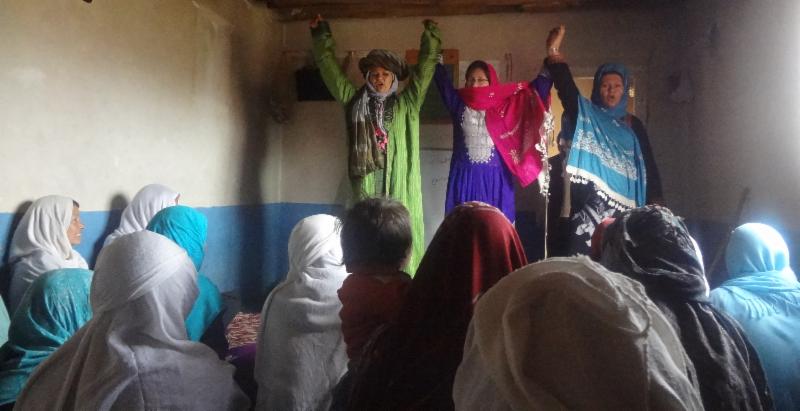
Seeing the workshops with the two groups was awesome. The workshops are all led by Afghan theatre artists, so lots of theatre and improv/role-playing type activities, but the ultimate goal is to come up with a community improvement project that the youth want to implement back in their hometowns. Once they come up with a plan, they have to write an official proposal and create a budget, and they are then given a small stipend to get their project started. The young women from Badakhshan came up with a plan to create a women's gym, because there really aren't any opportunities for women to participate in any physical activities, sports, or exercise. (I gave them a couple Pilates lessons to add to their regimen.) Some other projects have included things like an education program for street children, city clean-up initiatives, and a domestic violence support group.

Things quieted down a lot after the youth left. I then switched gears to the administrative side of my dissertation research, surveys and such, not as interesting. I've been able to see a bit more of the outside world on this trip. I went with the youth on their field trip day - the national museum, the gutted Darul Aman palace, and Babur Gardens (which date back to the 1500s!). Yesterday we visited a shop inside of a guest house that typically houses people visiting with the big NGO's like World Food Program, UNICEF, etc. We had to go through three security doors and when we finally got through it was like a military compound. There were foreigners lying on the grass and playing basketball. And there was a Japanese restaurant (the tempura was not bad)... it was surreal to say the least. One big bonus of shopping there (in addition to the tempura) was that we didn't have to do all the bargaining and haggling, which always stresses me out. I'm sure we paid more for that convenience though.

The man on the left has been the groundskeeper at the Darul Aman palace since it was built in 1920!
It's been a whirlwind and a great trip. The food is still fabulous, ('teka' kebab is my fav) and the Afghan people I've had the opportunity to meet are incredibly warm and kind. And all very tired of living in a country so broken by war.


.

Tuesday, May 26, 2015

Inside a Women’s Prison in Afghanistan

Our work in the Herat prison began with a performance called “Backbiters”. Now we’ve begun ongoing workshops. This post from Anna delves into the prison itself and why these women are here in the first place.


The Prison
The women’s prison is in a different compound from last time we were here. Their prior location was adjacent to the men’s prison and was needed for overflow of male prisoners. (The male prison is overcrowded with more than 3,000 inmates! The women total around 140.) It’s a good thing the women moved, as there had reportedly been problems with sexual abuse by the male guards, and now the women have their own separate location with only female guards.  The new compound also looks less like a prison. Instead of being stuck within a concrete enclosure with bars on the windows and heavy metal doors, the women can move freely between the buildings and the surrounding open space of the courtyard. Laundry hangs to dry between a few trees. The women sleep in communal dorm rooms with bunk beds, colorful blankets, and television. The women do not wear uniforms as is common in American prisons; they wear personal clothing as well as jewelry and make-up. This already makes for a more humane experience. Wearing uniforms dehumanizes individuals. From what I understand, the women can spend the day as they wish, and have available various activities supported by different NGO’s – tailoring, rugmaking, hairdressing, literacy classes, and an agricultural program where they learn to plant vegetables.

We met with the director of the women’s prison, an affable but authoritarian woman in her fifties. She told us she does not want the prison to look like a prison but instead like a dormitory with supportive activities for the women. She greatly welcomed our program.

This sounds very promising, and the conditions for the women don't seem so bad. Still, it is a prison and the women do not have their freedom. They are constrained within walls and they do not have control over their own lives. Of course, for some this may not be very different than their prior circumstances: many women in Afghanistan are not allowed to leave the house and all their activities are controlled and restricted by their husband, father, or brothers. Quite often they are beaten and abused. For some, prison must be preferable to what they endured outside it. Even so, to be in prison carries stigma, knowing you have been shamed and shunned by your community and family, stamped as a criminal and punished by society. Before you were controlled by your family, now you are controlled by the state. Your life is not your own. 

The Women
Given these difficult circumstances and with little hope for the future, many of the women have become depressed, self-harming and suicidal. One day we arrived for workshop and a woman came up to us and showed us her wrist, which had two deep burn marks. She had burned herself with a cigarette. I asked, why did you do that? She said, I was so full of angry feelings! She had wanted to see the doctor and the guard wouldn’t let her. She couldn't lash out at the guard so she lashed out at herself. Our fellow workshop leader, one of the young women from Simorgh Theatre, said she felt sick when she saw the burns and she couldn’t understand how this woman could do that to herself. But in the face of such utter lack of control and power over one’s life, this is sometimes the only way a person knows to cope and manage intense feelings and distress. This is why we are doing the workshops, to give these women an outlet in which they can express their feelings – and find more constructive and creative coping mechanisms. 

It is no wonder these women are depressed and frustrated when one learns the reasons they are  in prison. Many if not most are in prison for adultery--that is, they had sex outside marriage. This is a crime in Afghanistan. A girl falls in love with a boy; they have relations; now they are both in prison. Some women run away from home. This is not a crime per se, but it is assumed that they engaged in illicit relations. It is almost impossible for a woman to prove her innocence. Upon arrest, a woman has to submit to a virginity test, an extremely violating procedure that proves nothing. And certainly not if you happen to be a married woman. In many instances, the women have engaged in sex, but whether they were truly willing is questionable. It comes down to this: if a woman wants to leave her home, she needs the help of a man. The price for this is sex.

Why does an Afghan woman feel compelled to leave her home? Usually it's because of forced marriage and abuse. Many of the women spoke of the problem of marrying too young. As I was repeatedly told, a daughter is a toy to her father and a slave to her husband. But it does happen that she runs away for love.  A 17-year old girl in the prison ran off from home with a boy she loved, but since they now agreed to marry, they will both be released. This is one story that has a happy ending, but other girls are not so lucky. The boy no longer wants them, and now they are stuck in prison. After that, where can she go? Often the family will not accept her as she has brought "dishonor" upon them and may even threaten to kill her.

Even in the case of rape, a woman will be sent to prison for adultery. Because no one believes her. It is enough to be accused of infidelity by your husband to get locked up. Many women and girls seemed to be in prison based simply on someone’s accusation. In one case, a woman was raped by her husband’s brother, but the husband accused her of having an affair. The brother fled to Iran. The woman was sent to prison. She was pregnant but the husband said it wasn't his child and divorced her. She was released after eight months. The usual sentence for adultery is 1.5-3 years.

Some of the women are in prison for murder. They killed their husbands. No doubt for many it was a desperate act. They were married off young and abused by the husband and his whole family. But in some cases, the woman loved someone else and together they conspired to kill the husband and run away. The desperation is there but the justification is sometimes questionable.

It was challenging to learn the real reasons why the women were in prison, because, we were told, the women will often make up stories until they feel safe in speaking the truth or if they think it might benefit them in some way. But I also felt it was difficult to get accurate information from those we spoke with in prison management; they seemed too ready to dismiss the women’s circumstances. But after further discussion, they acknowledged the challenge that exists for a woman to be able to prove her innocence and how often she is in a compromised situation. The system is set up to fail these women. No matter the crime or reason, the real problem is that they have very little chance to defend themselves or escape their circumstances.

The prison psychologist shared a few particular cases with us:

·         One woman killed her husband with the help of her 14-year old son, because the father was a drug addict who tried to rape their 9-year old daughter. Now both the mother and her son are in prison. The mother was sentenced to 16 years.

·         A young woman had been beaten by her father so severely in her childhood she didn’t walk until she was six years old. As she got older her father wanted to marry her off, but she refused. She put gasoline on her father and burned him. She is sentenced to 18 years.

·         The psychologist spoke to us also about kidnapping and how entire families are swept up in the crime. A father and a brother may have conspired to kidnap someone for money. The police then raid their house and arrest everyone: the mother, the daughters, the sister-in-law, the grandmother, and everyone goes to prison. There are two young women in prison now for this crime. One was jailed at age 14 and sentenced to five years.


Here are additional stories from the women we worked with:

·         “A” has been in prison two months now. She killed her father because he was forcing the mother to have “temporary marriages” with other men (that is, sex for money). Finally the daughter couldn’t take it any longer. She took her brother’s gun and shot her father. Then she went to the police and said: “I have killed my father and I am happy I did it!” She is ashamed that he was her father, and she is proud she killed him so her mother doesn’t have to be “married” to another man again. "A" has a one month old baby with her in prison. I don’t know how long she has to stay there.

·         B is a feisty and outgoing young woman of 17 years old. She had an affair with a neighborhood boy. A couple of months later she got married, but her husband discovered she was not a virgin. So she said she had been raped. Her husband wanted to kill the other boy. But the neighbor called the national army for help and said the husband had a gun and also that he and B had stolen money. The national army came and beat up the husband so he ended up in the hospital. B had an altercation with the neighbor's daughter and cut her with a knife. Everybody was arrested, including the neighbor's daughter because she knew about the illicit relation and had not reported it, and was therefore accessory to the crime. The husband has now been released as well as the neighbor's daughter, but B and the neighbor boy were just sentenced to six months in prison for adultery. A complicated situation! B has a lot of anxiety and nervous problems. But she is very enthusiastic about the workshops and fully engaged. She’s our star participant. She even stayed up one night until one a.m. teaching the others in her room all the exercises she had learned!

·         C is in her early twenties and also very excited about our workshops and a main participant. She has been in prison for 7 months and has a 10 month old daughter. Her situation is a bit unclear. She had problems with her husband, and apparently he accused her of stealing and got her put in prison. The husband has now divorced her. She is about to be released and says her family supports her. But the first day we met she said to me that she wanted to find a family to take care of her daughter and give her an education, because if the daughter was left with her father he would marry her off early as he did her. She is so inspired by the workshops that she wants to continue doing theater when she gets out.

·         D is 27 years old. She was married at 15, but the husband became addicted to opium. He would abuse her and her child. She says her father and mother-in-law encouraged their son to beat her. They accused her of having sex with other men. She is now in prison for one year. She is worried about her 11-year old daughter who is with the in-laws; they don’t let her go to school and they beat her. The daughter comes to visit the mother every two weeks and says she’d rather stay with her in prison.

·         E is in her late forties and has a young child with disabilities. She has been active in all the programs the prison offers.  E has been in the prison 10 months and is sentenced to 16 years for killing her daughter’s husband. But she says she didn’t do it. I did not get to find out further and verify her story. Perhaps she did do it, or perhaps someone else did and she got the blame. Perhaps her daughter did it and she took the blame instead. There are several situations like this where the man died and the wife gets blamed for his death. There is little a woman can do to defend herself.

·         F is 22 and recently arrived in prison with her newborn son. She got there when her baby was 10 days old. Her husband’s second wife had died suddenly, and now she and her husband were accused of killing her by the wife’s brothers. She is in prison pending investigation and autopsy, and is hoping to be cleared.

·         Then we have G who is 19 and was working as a police officer in Kabul. One day her brother called and said, “Congratulations! Your father has found a husband for you.” But she did not want to get married, she wanted to go to the university and continue her work. The family summoned her back to Herat. She met her prospective fiancĂ©, but did not like him – so she shot him. Just like that. Apparently, her father and brother often visit her in prison so it seems they have a good relationship. Why did she not simply ask them to please not make her marry? She said she doesn’t know, she just got so angry. She didn’t think the family would listen to her. She has now been sentenced to hanging. And yet she always seems to be in a good mood when we see her!

The women are very happy when we come but this does not mean they aren’t suffering. And sometimes they are just too depressed to participate. But we have to keep showing up for them -- the workshops are ongoing so that they will have this support available for a long term.

The Children
As mentioned, the women have their children with them in prison. Children stay with their mothers until the age of 5, when they are placed in a child support center run by a non-profit. We visited and will be doing workshops there as well. It’s a good place and the children genuinely seem well-cared for. This is really encouraging to see. They get to visit their mothers every two weeks or so. The smaller kids who are with the mothers in the prison get sent to a kindergarten every day, where government employees’ children go. This is also a new development and did not exist four years ago when we last visited, as far as I know. It’s really good that the children can be with their mothers, but it is important that they are not stuck inside the prison all the time and can socialize with other kids. There are about 75 children living with their mothers in the prison. One girl was seven years old, but otherwise mostly toddlers and babies. We had several crawling around us as we did our workshop. The women are help each other take care of the babies, so the mothers can participate. 

Stay posted for further updates about the juvenile center and our other performances!

Wednesday, May 06, 2015

Afghan Creative Arts Prison Project - First Report

In April Joanna and Anna spent a month in Herat launching the Creative Arts Prison Project. We are working again with members of Simorgh Theatre, with whom we collaborated for the Theatre for Social Development project in 2011. Here is Anna’s first report.

Together again!
Back in Afghanistan after four years. Back to Herat to see the girls of Simorgh again! How wonderful to have the chance to work together again. Four years is a long time, and yet it’s like yesterday. But going from 13 to 17 or 16 to 20 makes a big difference. They’re young women now, all grown up. I hardly recognized some of them! And others look exactly the same. (For me, I just look older, as one of them pointed out. Well, yes, time does that!). We had a happy reunion and then we met the new girls who have joined the group. All in all, we are working with six young women, and then two young men who are helping out -- who really just want to be part of the process, and I’m so glad to see them again too! They are great guys. But this project is specifically for women by women.

Getting ready for action
All of us jumped headlong into our work together with great excitement and energy. For the first nine days we did training to prepare the group for the upcoming program. Workshops practicing various theatrical exercises in the morning, and in the afternoon rehearsals to develop a performance. In between we have lunch together. During the week I think to myself, “We are having such a wonderful and fulfilling time together that if this is all we do with the project I will be happy!”

Enjoying lunch together the Afghan way. 
But we have much more to accomplish. The goal of our project is to bring theater workshops to the women’s prison and the juvenile correction center as a way to offer psychosocial support -- to give the women and girls a safe, creative forum in which to express themselves and process their experiences through play and physical action. Research and experience has shown theater to be an effective tool in helping people heal trauma, build self-confidence and manage daily challenges. Eventually the women will have the opportunity to create their own plays. The aim is for this to be an ongoing program throughout the year.

We are training the members of Simorgh Theatre to lead the program and teach the workshops, as we are only here for a month and after we leave, the project will continue. We are also preparing a play that we will present first thing as an introduction to theater. That is, the Simorgh girls will present it. Joanna and I are directing and they perform. Many in Afghanistan have never seen a live theater performance and have no idea what it is. We want to show them that they can create a play just like this with their own stories.

A Common Problem
The play is called The Backbiters and centers on two gossiping women who make life difficult for a young woman, Nafisa, who wants to go to university. They talk bad about her and spread rumors that worry her family. Nafisa’s friend, a younger girl of thirteen named Fereshta, looks up to her and dreams of herself becoming a doctor one day. But Fereshta’s father has other ideas. He has decided she’s going to get married to an older, rich man who will give the father lots of money. Fereshta is devastated. The mother can do nothing to prevent it, but finds an ally in Nafisa’s mother and together they speak to the mullah (similar to parish priest). This mullah is a wise, learned man who talks to the father about the laws of Islam and that a girl must agree to who she marries and that Fereshta is much too young and should get an education. He points out what happened last year when the neighbor’s wife almost died because they couldn't find a female doctor to treat her. It’s good that girls study to become doctors! The father struggles with the idea but finally decides to forego the marriage and let his daughter study. Meanwhile, the backbiters have had some backlash and decide they must mend their ways.

Our story has a happy ending, but unfortunately this is not the case for many girls in Afghanistan. This is a common scenario – forced early marriage. Even though Islam does say a woman must agree to marriage and should be educated, many villages follow old tribal ways that have become tradition and conflated with Muslim practice. The community listens to the mullahs who often are corrupt or ignorant. And people are very concerned with what the community thinks and says about them because honor is everything. Gossiping old ladies is a common problem and families can be destroyed by bad rumors.

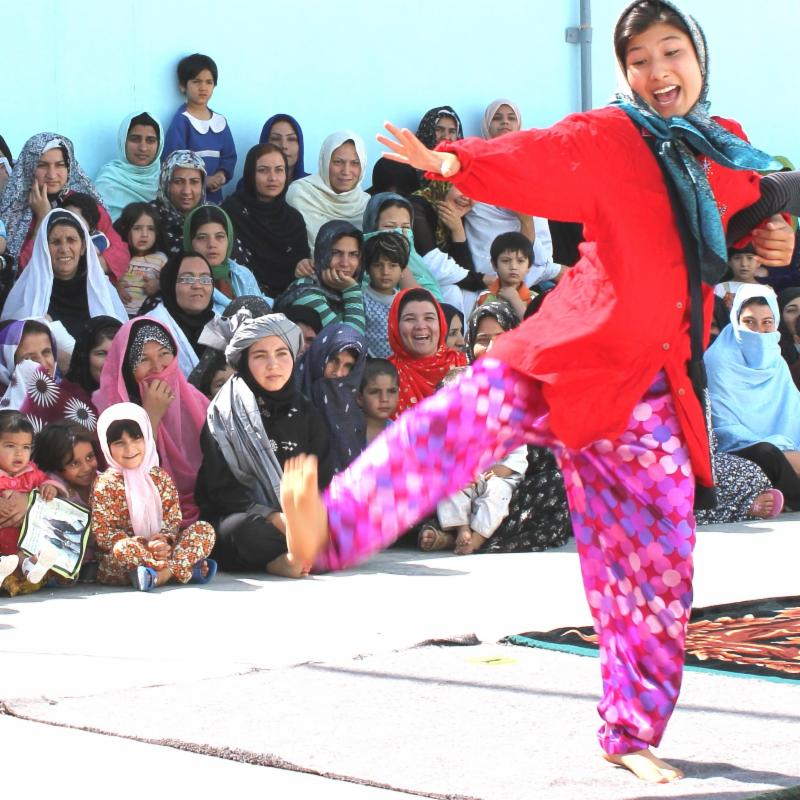
Our talented actors in Simorgh made the play very compelling and also added lots of humor to it. The two women playing the backbiters were funny and forceful, and the woman playing the father (yes, women only-troupe playing all characters) didn’t hold back in her portrayal of a gross, old man. It’s exaggerated but all too real.

Joanna guides a discussion planning for our workshops in the prison. 
Showtime in the Prison
The day arrived for us to present our play at the women’s prison! I wasn’t sure what to expect, or how the women would take to the show or the idea of doing workshops.  How open and accessible will they be, or perhaps closed off, resistant, even hostile? No telling what will happen, we’re breaking new ground. Here we go – "hala hamagi hamabaham bedboard!" ("Now everybody all together, let’s go!")

Well, it went fantastically well. About ninety women in all gathered to see the performance. They laughed and applauded and listened intently, and a few cried. Afterwards we did a talkback where they had a chance to speak about the show and go up on stage and engage with the characters. This is where I wasn't sure how it would work. But it worked very well. The women didn’t hesitate to engage. Some stood up and talked about their own personal circumstances. Others got up on stage to confront characters, especially the father. They argued with the father for not letting his daughter go to school and marrying her off so young. The woman playing the father stood her ground and said “Everyone in my family married before the age of 13, it’s no problem.” The prisoner countered, “And this is why we’re all in here!” Spontaneous applause broke out in acknowledgement. Another woman wanted to speak with the mullah and proceeded to rail against mullahs who are bad and want money and don’t follow proper Islam. She was animated and passionate in her speaking. All the women spoke with great passion. It was clear the play really resonated with them. It reflected and acknowledged their situation and gave them a chance to have a voice and speak out.

Afterwards, several women came up to me and exclaimed over and over again, “I’m so happy, I’m so happy, thank you for being here, thank you for presenting this play to us.” One woman seemed particularly taken and keen to connect. She asked my name and where I was from, I said USA and Sweden, and then she wanted to know which I liked better, Afghanistan or Sweden. I told her they are very different, and that I really like the people of Afghanistan -- they are so friendly and hospitable. She said, “We are friendly because you are. We respond to you. You are so nice and friendly, and we want to be friendly back.” At the end, she took a ring off her finger (a crocheted band with black beads) and put it on mine and told me, “This is a memory from me.”

I wonder what happened to her, what she did that she is here in prison. Did she run away from home? With her lover? From a threatened forced marriage? Or was she forced into marriage? And did she run away from an abusive husband? Was she raped? Did she kill somebody? These are many of the possible scenarios and circumstances that land a woman in prison in Afghanistan. I did not want to ask this woman right away, but Joanna and I have heard many stories since that first day.

More to follow! 

No photos beyond the barbed wire!

Saturday, February 21, 2015

Story update - Youth from Kunar and Balkh provinces

Good to be back in the US for a minute.  Here's the latest:

We have been conducting workshops for youth in the provinces over the last month focusing on volunteerism and community improvement.  Then we bring youth groups from two disparate provinces to our facility in Kabul for an intensive week of working together.  We will do this with 25 provinces across Afghanistan over the next two years.  

In Kabul, with the two groups, we work on building presentation skills, developing viable Action Plans to address their chosen community issues, and writing proposals so they can get matching funds for the small "seed grants" that we give them. 

This past week, we brought together groups from Kunar and Balkh provinces.  Kunar is a very rural, extremely conservative Pashtun province on the Pakistan border.  Balkh is more a progressive northern province with Tajik, Uzbek and Hazara tribes.  Our point was to bring the youth from these diverse communities together to explore commonalities, discuss differences, and find unity in their goals of imagining and creating the New Afghanistan.  This is where our great theory of peaceful collaboration bumps into reality. 

To accommodate the conservative Kunar group, we conducted separate workshops for the females, which would have been fine, but the Balkh girls, being more urban and sophisticated, wanted to work with the guys as a team.  All the Kunar girls were here with their brothers (otherwise they would not have be able to travel) and were completely under their control.  We had many a long talk with the brothers about why their sisters couldn't do even the most simple, safe exercise with the men, even while staying completely covered.  The answer was that, if word got back to their village that their sisters had been face to face with strange men, it would be seriously dangerous for the entire family.  And who would bring back this information?  The other guys from Kunar, even though they are their friends!  The honor of the entire family rests on the woman's shoulders, and it seems no one outside the family unit can be trusted.  On the bright side, the women themselves were strong, well-spoken and brave.  I was more impressed with their calm and clear presentations than the men's.  It is a tragedy that these brilliant young women cannot make a single decision for themselves.... yet. 

Here is an interesting example:  On the first day, the groups presented their "community profiles".  The Kunar men made a fine presentation about how trees in Kunar are being cut down at an alarming rate which is leading to soil erosion and polluting the rivers.  The Kunar women did a presentation about violence against women with shocking visuals of women with ears cut off, noses cut off, beaten badly... and also spoke about how women are blamed for crimes they haven't committed and often traded to pay off debts.  Later, in speaking directly with the brothers of the Kunar girls, I asked why their project isn't about violence against the women and the women's project about the environment?  Which is more important to you, I asked, cutting a woman or cutting a tree?  Isn't a woman more valuable than a tree?  They actually were taken aback; I don't think they ever thought of it that way.  And now they are working on both issues together!  After that discussion, the Kunar men began presenting about violence against women... and the environment too.  Success!... a small one but mighty! 

Now both groups have returned to their provinces, and we will be monitoring their progress over the next month.  We feature theatre,  photography, mural painting, radio plays, poetry and music in our training as great ways for them to bring their issues to the wider community.  Communication... this is where the arts excel!  However, you can see the limitations of how, where, when and with whom they can present their art.

Our Afghan Training Team
Next we go to Parwan and Kandahar, two other diverse provinces, and then bring these groups together in Kabul for another intensive session.  Over the next two years, we’ll reach all of the provinces… inshallah.

Tuesday, February 17, 2015

First Impressions of Afghanistan and the Creativity in Action Program

Heddy Lahmann-Rosen, a Bond Street company member, just returned from her first visit to Afghanistan with Michael and Joanna for our new, two-year Creativity in Action program. Heddy will visit Afghanistan a handful of times during the course of the program, acting as our Outside Evaluator, and eventually using this research in her PhD thesis. 


I'm a little late to the party on getting a blog entry going for my time with the Creativity in Action program in Afghanistan, but I'll do my best to give a flavor of the whole experience. 

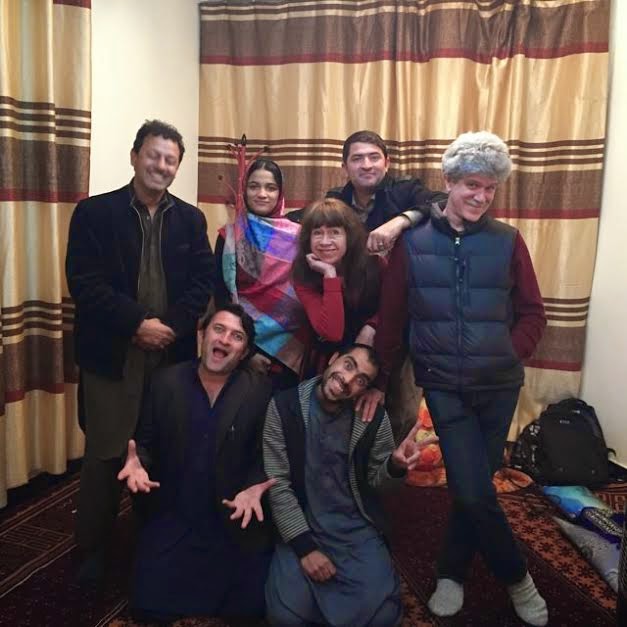
I embarked upon the adventure to Kabul with Michael and Joanna in mid-January, and I stayed for 2 weeks. Joanna and Michael are still there working away at building this program and making sure it's got the wings to keep flying when they come back.

My first week primarily consisted of a good amount of administrative work and preparation for this big and ambitious program. This baby is no small feat! The Creativity in Action program is 2-year youth development project that includes 15 young people from each of 25 provinces across Afghanistan (375 youth in all!). The program is providing jobs for local Afghan artists to work with youth– teaching them about expressing themselves and accessing their creativity, and then mentoring them and supporting them as they create and implement improvement projects in their own communities. If you can't tell, I'm pretty excited about it. So excited in fact that I'm centering my (eventual) dissertation around this phenomenal program!

So what's Kabul like? That’s kind of a tough question to answer, because I didn't really see so much of the outside world except through the car window. What did I see out the window? Well, Kabul is less conservative than other parts of the country. Some women wear burqa’s, although there are very few women on the streets anyway. I’d say it’s like 90% men. Unpaved roads for the most part. The air outside smells smoky from the ovens they use to warm homes. It’s winter and pretty cold – ranging from around 35 degrees F to 50. The heating isn't what we’re used to in the US, so lots of layers are necessary. It even snowed a few days while I was there!

The driving in Kabul is really something. It’s positively fearless (except for a Western passenger like me) – I mean, we navigated through the most insane tangle of cars on the way home one night– I thought we might be in serious trouble and stuck there for awhile (because if we were in the US, we would have) – but somehow our driver just wriggled, honked, and near-missed his way through. It was something to behold. 

The food is awesome! Maybe with the exception of breakfast, but that’s just because they don’t really do breakfast like we do. But everything else was AMAZING. Flower street, which had several florists up and down the street, was very pretty! Butcher street is not so pretty, as you might imagine.

The Afghan people I had the opportunity to meet are lovely. Very kind and warm. I met and spent some time with the Afghan artists who are/will be leading the youth workshops and are long time friends and creative partners of BST. They were all so eager to share their thoughts and experiences with such openness and enthusiasm. It was a major highlight!

I also had the opportunity to see some of the youth workshops in action in the Balkh region. I had such a wonderful time  meeting and getting to know the youth participating. They're a very inspirational group. They were incredibly warm and welcoming and had many questions about my doctoral program and my experience of being in their country. They are all very concerned and passionate about the state of their community and country and are eager to talk about the problems they see and ideas for ways to go about addressing them. I was pretty floored by how engaged they were with the whole process from the get-go. After I left, the youths from Balkh and Kunar met in Kabul for a combined workshop. This program provides a unique opportunity for connecting young passionate problem-solvers from across the country and across ethnic divides. It's killing me to have missed the Kabul workshop! But alas, my spring semester classes beckoned me back. I've been living vicariously through email updates from Joanna on the collective workshop with the 2 groups in Kabul- I will let her tell it- from what I read, the experience is something truly special.

I'm already looking forward to my return!


Thursday, February 12, 2015

Youth from across Afghanistan collaborate in Kabul

Joanna keep us up-to-date about the goings-on in Kabul. Afghan Project Leaders have completed workshops in Balkh and Kunar, and now youth from both groups are in Kabul together for a week of workshops, training, and idea-sharing.
Joanna Reports:

This morning the participants were all happily doing warm-ups and exercises. Now they are creating their "community mapping" (drawing their region) and then their "ideal communities" (as mixed Kunar-Balkh groups, hopefully sharing their ideas about what makes an "ideal" community).  

The sounds of laughter fill the house as it should be.  

They did their "community profiles" last night.  Very interesting -- each presentation was really really well done!  The issues that rise to the top are environment, medical, and women's rights.  The Balkh girls were all about pre-marriage testing to prevent certain diseases, and the need for vaccinations.  Both the Balkh and Kunar guys were most concerned by the wanton cutting of trees, soil erosion and proliferation of trash.  And the Kunar girls showed some shocking photos of the violence against women, including trading girls for bad debts, and blaming women for the crimes of others.  Unbelievable!  

We worked with the girls all together this morning and the Kunar girls are ready to speak out... but still cover up the second a male or a camera is anywhere close.  Three are daughters of other active women, and the other two need some gentle coaxing... but that's okay.  They will all help each other I hope.  

And then, two days later…

The workshops are continuing well! It is super-busy and also super-fun.  

We have had some great guests speaking about youth activism, how to meet challenges, how to get the government to listen, etc.  And today we went to the Presidential Palace!  It was grand... and an amazing experience for the youth -- like a trip to the White House to meet ... well, okay, not Obama... but maybe Joe Biden.  


We had a two-hour session with one of the top people during which the participants stood up and talked about their issues. Wow.  Can you imagine getting a chance to air all your grievances with some top government person who is actually listening and writing it all down. Even the Kunar girls all covered up stood up and gave their rant.  The guy was very moved, and then he told us that he had also had this idea to set up creative youth projects in different provinces, then bringing the groups together and implementing the projects.  So he was very happy that we were doing just that.  

This Balkh-Kunar collaboration is the first of many in the coming years. Groups from across Afghanistan will come to Kabul and share ideas with group members from a different province, each with their own issues, solutions, history, and culture. Stay posted for more updates from the field! 

Wednesday, October 30, 2013

Don't Abandon The Women of Afghanistan!

In an opinion piece on CNN, Paula Dobriansky and Melanne Verveer say:

"Nothing is more important for Afghanistan than building on the liberalizing achievements of the past decade and preventing a slide back toward repression.


This is why it is crucial to retain and expand the hard-won rights of Afghan women.  Gender equality isn't just a matter of moral fairness -- it's essential to the country's economic and political health and to ensuring that the nation has a secure, peaceful and stable future."


And this is why it is so important for our Afghan women's theatre troupes to get out there and get out the vote!  


You can read the full article here: Don't Abandon the Women of Afghanistan.


Thursday, September 26, 2013

Afghan Women Speak Out through Theatre

Extra, extra, read all about it!


Bond Street Theatre 

Afghan Women Speak Out through Theatre

We have launched an Indiegogo campaign to support Afghan Women's Voting Rights in preparation for the April 5, 2014 elections, and you can make a huge difference!


This is a time of hope and possibility.  A new generation is voting for the first time in Afghanistan, and half of them are women.  Women's right to vote is a hard-earned victory, and yet many women are unaware of their right to vote.  

This is a time for crucial change.  In the past decade, women have made great strides, setting Afghanistan on a promising course. But conservative factions are working hard to reverse these advances and prevent women from enjoying the most basic human rights.  

The time is now to stand with the women of Afghanistan.  We are asking for your support to help our all-women's theatre troupes bring vital information to women who are isolated by tradition, location or incarceration. Your contribution goes directly to the women's groups!  To reach women across the country,  

Women's voice in government and participation in the election is essential to protect and advance their rights! 

"This theatre project has given me new courage to speak out!"
  (Ayesha, member of Nangarhar Women's Theatre troupe in Jalalabad.) 


Bond Street Theatre
 has been working for Afghan women for more than 10 years.  We trained four women's theatre groups to create theatre -- by women, for women -- to spread the word about women's right to vote, why each vote counts, and how to register. They are a first in Afghanistan! 

These women are role models: they encourage women and girls to speak out. Theatre shows like these have a ripple effect through the community and a huge impact. 

In order to reach as many women (and men) as possible, we must raise $10,000.
   
 Visit our Indiegogo page Afghan Women Speak Out through Theatre to contribute! 

Please spread the word via email, Facebook, Twitter or actual face-to-face interaction!

Thank you for your support!   
The Bond Street Team and the Afghan Women's Theatres


ClosingBond Street Theatre
Blue Like us on Facebook Follow us on Twitter View our videos on YouTube Visit our blog 

Bond Street Theatre initiates theatre-based projects for education, conflict resolution, and healing in areas of conflict and poverty globally.  Bond Street Theatre is a not-for-profit 501(c)(3) organization, and NGO in association with the UN-DPI.   
Please support our campaign for Afghan women:
Bond Street Theatre
2 Bond Street, New York, New York 10012   --  212-254-4614  --   info@bondst.org     www.bondst.org

Friday, August 30, 2013

Afghanistan: New Courage to Get Out the Vote thru Theatre

An update from the field from Olivia :

Hello from sunny - actually, a bit rainy today - Kabul, where we just finished a week of pre-program training workshops for the Voter Education and Fraud Mitigation Project. Every morning this week from 8-12:30, we have been leading workshops for 2 members of the Nangarhar team, 2 members of the Kandahar team, and 8 members of the Kabul team in the tools necessary to implement this project from now until the elections next April.

The project has many parts: 1) a series of educational and mobile performances to spread crucial election information to Afghan citizens and engage them in community dialogue about the issues that matter to them in the presidential elections; 2) Leadership Workshops for youth that engage young people (16-22 ish) in discussion about why voting is important and the value of democracy; and 3) engaging election officials and independent monitors as allies to share information and findings.  Because of all these moving pieces, this week of workshops went by like a flash trying to communicate all the necessary information!

Before I arrived, Michael and Joanna had a series of meetings in Kabul with the Independent Election Commission, Ministers, and others to let them know about this project. They are excited about the project’s potential, and we have partnered with the IEC in the 4 provinces where the teams are performing.  That is good news for the local teams, who have access to more voting information through this partnership.

The workshops focused on the content of the shows, the post-performance activities, the evaluation measures for the project, and the curriculum for the Leadership Workshops. I can hardly believe that the week is over and I am writing about this in the past tense!  We worked quickly this week, but it hardly feels like work to be in a room full of people who are all getting the chance to do what they love for a good cause.

On the first day of the workshop, we had a discussion about why theatre may be a good medium to spread this information. The IEC and other groups have television messages and radio dramas that promote the elections. As our partners said, not everyone has access to TV and radio all the time - and both TV and radio can be switched off. Having a real, live person performing in front of you creates a direct and emotional relationship, one that is more likely to lead to a change in action.

The post-performance dialogues will also help in that regard. The dialogues are inspired by Theatre of the Oppressed techniques, and ask the audience to come up with alternate solutions to the issues presented on stage. In addition to thinking of solutions, audience members are encouraged to take the stage themselves to try their ideas with the actors. This technique allows audiences to make action plans, and to engage in community discussion about issues that may not come up in everyday life.

Every day, we spent some time discussing common voting issues and using those discussions to make pieces of theatre. What struck me was that many of the issues identified in Afghan culture are common issues in American elections as well - folks who do not believe that one vote matters and do not trust the democratic system, and so choose not to vote at all.  That’s common everywhere that elections are held, I think, so we spent lots of time discussion potential solutions. First and foremost, people need to have confidence in the election system to believe that their ballot will make a difference - so the performances that the troupes are creating for this project will all promote that confidence.

Using Image Theater, narration, and improvisation, the participants made and performed short pieces addressing those issues and many more. They took on women’s right to vote and those who believe  women shouldn’t vote, the lack of voting infrastructure that causes long lines and too few ballots, bribery and threats from candidates, access to the polls for folks living with disabilities (which turned into a discussion about the larger responsibility of all Afghans to ensure all can participate in the elections), and the value of one vote.  

Now that they have a lot of content, the troupes are going home to finalize scripts that merge some of the stories and issues. Once the scripts are done and rehearsed, each troupe will perform over 50 shows before April. The Kabul team is travelling to Bamyan and Kunduz to perform, rather than staying in Kabul where the IEC has a strong voter education program.  They will also conduct the Leadership Workshops for youth in those provinces, which includes a mock campaign to illustrate some of the common joys and issues with the elections.

As the troupes begin to perform in August, we will have more information about the impact of these performances and the experiences that our partners are having in the field. Right now, we are proud and tired, and excited for what this project has in store.

This project is my first time in the country, and I have thoroughly enjoyed myself. Though our partners tell me I look Afghan, I know I still stick out a bit. All the folks I have met here are warm, welcoming, and thankful, in addition to being the best hosts around.  Even though it is Ramadan and our partners are fasting, they are all focused and dedicated on the work at hand (not to mention talented). I cannot wait to hear the stories of their successes, and to return to work with them again.

Ayesha

Ayesha is studying biology in University, and teaches human rights workshops for women all over Nangarhar province. But it took me almost a week to find out all that information. Ayesha is also the director of the women’s troupe of the Nangarhar Theatre, one of our partners for the Voter Education and Fraud Mitigation Project.  I met her in Kabul, where she came with the director of the men’s troupe for a week of training and program set-up.

When I met Ayesha, she was shy, giggly, and self-conscious. Jalalabad is a more conservative area than Kabul, and she dresses in long black garments over her other clothing all the time. She would not make eye contact with Michael, and she was decidedly uncomfortable in our daily theatre warm-ups. She had never done theatre before - but she had certainly taught workshops.

Ayesha, like all Afghans, is a perfect host. She invited us into her room for melon nearly every night, and it is those conversations that made her begin to open up. We learned about her work with the women and her life in Jalalabad.  Since she was staying in the same hotel that we were, it was easy to have these after-dinner chats, particularly since she was fasting and much happier after her dinner.  It was during the first of these conversations that she told us that this workshop is giving her new courage.

Little by little over the week, Ayesha began to open up and come out of her shell.  We learned that she has quite a silly side and loves to joke around. She also gave me the best nickname I have ever had - ILoveYou, which is what my name sounds like to her.