Showing posts with label training. Show all posts

Saturday, February 21, 2015

Story update - Youth from Kunar and Balkh provinces

Good to be back in the US for a minute.  Here's the latest:

We have been conducting workshops for youth in the provinces over the last month focusing on volunteerism and community improvement.  Then we bring youth groups from two disparate provinces to our facility in Kabul for an intensive week of working together.  We will do this with 25 provinces across Afghanistan over the next two years.  

In Kabul, with the two groups, we work on building presentation skills, developing viable Action Plans to address their chosen community issues, and writing proposals so they can get matching funds for the small "seed grants" that we give them. 

This past week, we brought together groups from Kunar and Balkh provinces.  Kunar is a very rural, extremely conservative Pashtun province on the Pakistan border.  Balkh is more a progressive northern province with Tajik, Uzbek and Hazara tribes.  Our point was to bring the youth from these diverse communities together to explore commonalities, discuss differences, and find unity in their goals of imagining and creating the New Afghanistan.  This is where our great theory of peaceful collaboration bumps into reality. 

To accommodate the conservative Kunar group, we conducted separate workshops for the females, which would have been fine, but the Balkh girls, being more urban and sophisticated, wanted to work with the guys as a team.  All the Kunar girls were here with their brothers (otherwise they would not have be able to travel) and were completely under their control.  We had many a long talk with the brothers about why their sisters couldn't do even the most simple, safe exercise with the men, even while staying completely covered.  The answer was that, if word got back to their village that their sisters had been face to face with strange men, it would be seriously dangerous for the entire family.  And who would bring back this information?  The other guys from Kunar, even though they are their friends!  The honor of the entire family rests on the woman's shoulders, and it seems no one outside the family unit can be trusted.  On the bright side, the women themselves were strong, well-spoken and brave.  I was more impressed with their calm and clear presentations than the men's.  It is a tragedy that these brilliant young women cannot make a single decision for themselves.... yet. 

Here is an interesting example:  On the first day, the groups presented their "community profiles".  The Kunar men made a fine presentation about how trees in Kunar are being cut down at an alarming rate which is leading to soil erosion and polluting the rivers.  The Kunar women did a presentation about violence against women with shocking visuals of women with ears cut off, noses cut off, beaten badly... and also spoke about how women are blamed for crimes they haven't committed and often traded to pay off debts.  Later, in speaking directly with the brothers of the Kunar girls, I asked why their project isn't about violence against the women and the women's project about the environment?  Which is more important to you, I asked, cutting a woman or cutting a tree?  Isn't a woman more valuable than a tree?  They actually were taken aback; I don't think they ever thought of it that way.  And now they are working on both issues together!  After that discussion, the Kunar men began presenting about violence against women... and the environment too.  Success!... a small one but mighty! 

Now both groups have returned to their provinces, and we will be monitoring their progress over the next month.  We feature theatre,  photography, mural painting, radio plays, poetry and music in our training as great ways for them to bring their issues to the wider community.  Communication... this is where the arts excel!  However, you can see the limitations of how, where, when and with whom they can present their art.
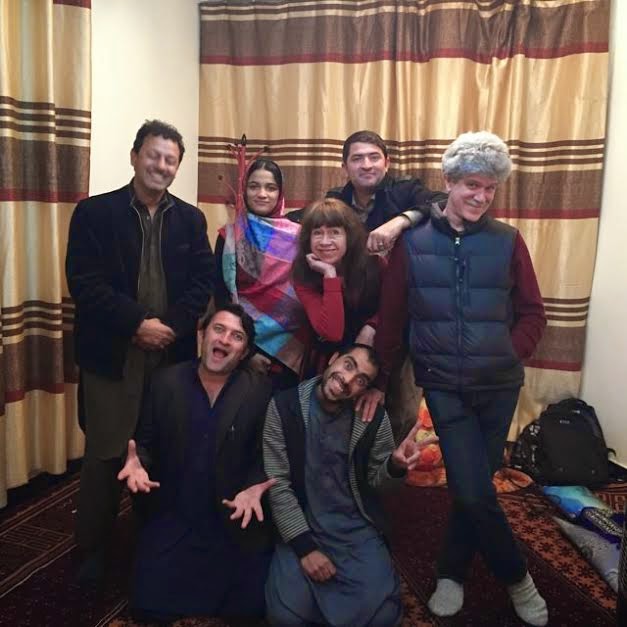
Our Afghan Training Team
Next we go to Parwan and Kandahar, two other diverse provinces, and then bring these groups together in Kabul for another intensive session.  Over the next two years, we’ll reach all of the provinces… inshallah.

Friday, February 13, 2015

Another Workshop Update from Kenya

During this workshop, for adults from ten different tribes in Kenya, Jessy Hodder facilitated 11 different activities from our Theatre for Social Development Training Manual. Keep reading to learn the participants' favorite activities and Jessy's thoughts on this experience! 

I facilitated a workshop today (3 hours) for 33 Kenyan adults (20 women and 13 men).  The youngest was 24, the oldest was 41, and the average age was 29.  They originated from 10 different tribes.  I originally thought this might create a little friction, but they seemed to work very well together.  They were not at all shy.  Most of them had great self-confidence, and they all wanted to be involved in the activities.  I was pleasantly surprised!  


Passing Energy 
Sports, especially those involving balls, are very popular in Kenya.  While they enjoyed throwing the ball of energy, I found they especially loved kicking the ball of energy around like a soccer ball.  I think this really underlines their love for soccer here.  Soccer is one of the top pastimes in Kenya.

The Wind Blows for . . . 
It took a few tries for them to understand the point of the game, but once they got it, they had a blast.  They told me afterwards that they want to use this activity in their own communities to get to know their people better.  However, I did find it interesting that if a man and a woman had to fight for a seat, the woman would generally allow the man to take it.  This meant that a lot of women ended up in the center of the circle!

The Prop Game 
They were very creative with the items that I put in front of them.  I introduced each item as "magic" - when a person touches the "magic" object, it takes on a new function/ it turns into something else.  A water bottle transformed into everything from a shoe polisher to a cell phone.  They were also very keen to move around and get down on the floor for their mimes.  However, the idea of "magic" in Kenya is an interesting one, particularly because of the history of shamans and witch doctors.  Magic, in many ways, is very real to people here, and they see it as a powerful force.  I think this might be something interesting to consider. 

Group Stop, Start, and Jump
The group listened SO intently, and they were very concentrated on getting it right.  They didn't want to stand out or let the group down.  Again - group mentality.  

Machines with a Theme
It was clear that some of their movements and sounds emulated parts of machines that can be found in town - drilling machines, generators, welding machines, and maize grinders.  

Secret Friends and Enemies 
Since I was shut down last time when I mentioned the idea of "enemy," I asked the adults to decide what we should call the "friend" and the "enemy."  They decided on "angel" and "disease"/ "death."  I thought this was an interesting choice, as death is something very common here.  It is a reality.  It is something much easier for them to talk about and confront than the idea of an "enemy."  

Awooga! 
This was a great activity to get them moving after lunch when they seemed a little sluggish.  Because of their skirts, it was a little difficult for some of the women to do a star jump.  They still gave it a good college try!

Making Group Shapes and Scenes 
The way they made a sofa set with their bodies was identical to the way in which the female survivors formed theirs in my last workshop.  I thought this was very interesting and may suggest similar perspectives between the groups.

Trust Walks 
When I asked the participants to pair up with someone, they chose partners of all types: men were with men; women were with women; and men were with women.  I was surprised to see some males pair with females.  I made the space in which they could walk smaller and smaller, until it became very difficult to steer clear of other leader/follower teams.  It made them giggle when they bumped into someone, but it caused the leaders to focus even more on keeping their follower safe.  

Snowballs 
As it was a bigger group, and our circle was very large, I asked them to throw their snowballs into the center and scramble to pick up a different one from the pile. We didn't have enough time to write out full stories, so I just had them write words or phrases that they could act out for the group.  The two categories which I felt were most successful were animals and objects.  One by one, as they felt led, participants would enter the circle and act them out.  All of the animals were those which you often see in our village (chickens, cows, goats, dogs, etc.), and the objects were all things that you could find on a village homestead (tree, gas stove, etc.)

Creating Puppets out of Found Objects 
They worked in four groups, each of which produced one or two puppets.  Materials included paper, cardboard, small boxes, toilet paper rolls, plastic grocery bags, trash bags, egg cartons, tape, scissors, and pens.  These are all objects that can easily be found on the streets.  They worked very well together, and they remained engrossed in the activity for at least 30 minutes.  When asked to use their puppets to create a small play, I found it interesting that the representatives from each group (puppeteers) were all male.  The plays all had moral significance and referenced God.


When asked which activities they enjoyed most, they identified the following:
1.  The Wind Blows for . . .
2.  Snowballs
3.  Machines with a Theme
4.  Passing Energy in a Circle
5.  Trust Walks

All in all, I was reminded that people draw upon what they know.  They do not often think outside of their immediate experience.  I think this is a good thing to remember when being creative so that we can find ways of helping participants think outside of the box.
  

Thursday, February 12, 2015

Youth from across Afghanistan collaborate in Kabul

Joanna keep us up-to-date about the goings-on in Kabul. Afghan Project Leaders have completed workshops in Balkh and Kunar, and now youth from both groups are in Kabul together for a week of workshops, training, and idea-sharing.
Joanna Reports:

This morning the participants were all happily doing warm-ups and exercises. Now they are creating their "community mapping" (drawing their region) and then their "ideal communities" (as mixed Kunar-Balkh groups, hopefully sharing their ideas about what makes an "ideal" community).  

The sounds of laughter fill the house as it should be.  

They did their "community profiles" last night.  Very interesting -- each presentation was really really well done!  The issues that rise to the top are environment, medical, and women's rights.  The Balkh girls were all about pre-marriage testing to prevent certain diseases, and the need for vaccinations.  Both the Balkh and Kunar guys were most concerned by the wanton cutting of trees, soil erosion and proliferation of trash.  And the Kunar girls showed some shocking photos of the violence against women, including trading girls for bad debts, and blaming women for the crimes of others.  Unbelievable!  

We worked with the girls all together this morning and the Kunar girls are ready to speak out... but still cover up the second a male or a camera is anywhere close.  Three are daughters of other active women, and the other two need some gentle coaxing... but that's okay.  They will all help each other I hope.  

And then, two days later…

The workshops are continuing well! It is super-busy and also super-fun.  

We have had some great guests speaking about youth activism, how to meet challenges, how to get the government to listen, etc.  And today we went to the Presidential Palace!  It was grand... and an amazing experience for the youth -- like a trip to the White House to meet ... well, okay, not Obama... but maybe Joe Biden.  


We had a two-hour session with one of the top people during which the participants stood up and talked about their issues. Wow.  Can you imagine getting a chance to air all your grievances with some top government person who is actually listening and writing it all down. Even the Kunar girls all covered up stood up and gave their rant.  The guy was very moved, and then he told us that he had also had this idea to set up creative youth projects in different provinces, then bringing the groups together and implementing the projects.  So he was very happy that we were doing just that.  

This Balkh-Kunar collaboration is the first of many in the coming years. Groups from across Afghanistan will come to Kabul and share ideas with group members from a different province, each with their own issues, solutions, history, and culture. Stay posted for more updates from the field! 

Friday, August 30, 2013

Afghanistan: New Courage to Get Out the Vote thru Theatre

An update from the field from Olivia :

Hello from sunny - actually, a bit rainy today - Kabul, where we just finished a week of pre-program training workshops for the Voter Education and Fraud Mitigation Project. Every morning this week from 8-12:30, we have been leading workshops for 2 members of the Nangarhar team, 2 members of the Kandahar team, and 8 members of the Kabul team in the tools necessary to implement this project from now until the elections next April.

The project has many parts: 1) a series of educational and mobile performances to spread crucial election information to Afghan citizens and engage them in community dialogue about the issues that matter to them in the presidential elections; 2) Leadership Workshops for youth that engage young people (16-22 ish) in discussion about why voting is important and the value of democracy; and 3) engaging election officials and independent monitors as allies to share information and findings.  Because of all these moving pieces, this week of workshops went by like a flash trying to communicate all the necessary information!

Before I arrived, Michael and Joanna had a series of meetings in Kabul with the Independent Election Commission, Ministers, and others to let them know about this project. They are excited about the project’s potential, and we have partnered with the IEC in the 4 provinces where the teams are performing.  That is good news for the local teams, who have access to more voting information through this partnership.

The workshops focused on the content of the shows, the post-performance activities, the evaluation measures for the project, and the curriculum for the Leadership Workshops. I can hardly believe that the week is over and I am writing about this in the past tense!  We worked quickly this week, but it hardly feels like work to be in a room full of people who are all getting the chance to do what they love for a good cause.

On the first day of the workshop, we had a discussion about why theatre may be a good medium to spread this information. The IEC and other groups have television messages and radio dramas that promote the elections. As our partners said, not everyone has access to TV and radio all the time - and both TV and radio can be switched off. Having a real, live person performing in front of you creates a direct and emotional relationship, one that is more likely to lead to a change in action.

The post-performance dialogues will also help in that regard. The dialogues are inspired by Theatre of the Oppressed techniques, and ask the audience to come up with alternate solutions to the issues presented on stage. In addition to thinking of solutions, audience members are encouraged to take the stage themselves to try their ideas with the actors. This technique allows audiences to make action plans, and to engage in community discussion about issues that may not come up in everyday life.

Every day, we spent some time discussing common voting issues and using those discussions to make pieces of theatre. What struck me was that many of the issues identified in Afghan culture are common issues in American elections as well - folks who do not believe that one vote matters and do not trust the democratic system, and so choose not to vote at all.  That’s common everywhere that elections are held, I think, so we spent lots of time discussion potential solutions. First and foremost, people need to have confidence in the election system to believe that their ballot will make a difference - so the performances that the troupes are creating for this project will all promote that confidence.

Using Image Theater, narration, and improvisation, the participants made and performed short pieces addressing those issues and many more. They took on women’s right to vote and those who believe  women shouldn’t vote, the lack of voting infrastructure that causes long lines and too few ballots, bribery and threats from candidates, access to the polls for folks living with disabilities (which turned into a discussion about the larger responsibility of all Afghans to ensure all can participate in the elections), and the value of one vote.  

Now that they have a lot of content, the troupes are going home to finalize scripts that merge some of the stories and issues. Once the scripts are done and rehearsed, each troupe will perform over 50 shows before April. The Kabul team is travelling to Bamyan and Kunduz to perform, rather than staying in Kabul where the IEC has a strong voter education program.  They will also conduct the Leadership Workshops for youth in those provinces, which includes a mock campaign to illustrate some of the common joys and issues with the elections.

As the troupes begin to perform in August, we will have more information about the impact of these performances and the experiences that our partners are having in the field. Right now, we are proud and tired, and excited for what this project has in store.

This project is my first time in the country, and I have thoroughly enjoyed myself. Though our partners tell me I look Afghan, I know I still stick out a bit. All the folks I have met here are warm, welcoming, and thankful, in addition to being the best hosts around.  Even though it is Ramadan and our partners are fasting, they are all focused and dedicated on the work at hand (not to mention talented). I cannot wait to hear the stories of their successes, and to return to work with them again.

Ayesha

Ayesha is studying biology in University, and teaches human rights workshops for women all over Nangarhar province. But it took me almost a week to find out all that information. Ayesha is also the director of the women’s troupe of the Nangarhar Theatre, one of our partners for the Voter Education and Fraud Mitigation Project.  I met her in Kabul, where she came with the director of the men’s troupe for a week of training and program set-up.

When I met Ayesha, she was shy, giggly, and self-conscious. Jalalabad is a more conservative area than Kabul, and she dresses in long black garments over her other clothing all the time. She would not make eye contact with Michael, and she was decidedly uncomfortable in our daily theatre warm-ups. She had never done theatre before - but she had certainly taught workshops.

Ayesha, like all Afghans, is a perfect host. She invited us into her room for melon nearly every night, and it is those conversations that made her begin to open up. We learned about her work with the women and her life in Jalalabad.  Since she was staying in the same hotel that we were, it was easy to have these after-dinner chats, particularly since she was fasting and much happier after her dinner.  It was during the first of these conversations that she told us that this workshop is giving her new courage.

Little by little over the week, Ayesha began to open up and come out of her shell.  We learned that she has quite a silly side and loves to joke around. She also gave me the best nickname I have ever had - ILoveYou, which is what my name sounds like to her.

Thursday, September 13, 2012

Kandahar Theatre Update 2: Safe Haven

Dear all, 
Things have been a bit dicey lately.  Our Afghan partner called us at 5:30am this morning to tell us to pack our bags and we were to evacuate Jalalabad for a few days. He would come by and take us to stay to his house in a small village outside the city.  We hadn’t heard a thing about this nasty film (and it is really awful – I am appalled even as an artist) so it was all a shock.  Now we are on lockdown at the hotel.  We decided it would be more dangerous to get in a car and drive to the village and endanger his family.  We are such a liability!  We put everyone in danger.
So the program is on hold for today and especially tomorrow, Friday – the usual day of prayer and protest.  
To put our friends at home at ease, I do think our hotel is a safe haven. We are staying in our rooms with meals delivered up from the kitchen.  There are a bevy of guards at the front gate and they have added more.  Then there is a long driveway (through a very nice garden) up to the front of the building.  They frisked our male escort on his way in, and stopped even the women… so they are really being careful.  
One of our partners came over to deliver burqas for me and Monireh, and some additional details to add to Michael’s Afghan attire.  Meanwhile the Afghans have been telling people (and only few people know we are here) that we are from Australia.  I usually say Canada, but whatever.
The trainings were really going well – we were all very pleased!  It’s a shame to make this break in the process right now.  We had just started discussions on what topics the shows should address.  The Kandahari group is really learning a lot.  Besides the obviously new stuff – our crazy warm-ups, the stilts, funny routines, etc. – many of the acting techniques are very new… even the mime.  They had some image theatre from Kayhan, but we are dealing with purely actors’ training first, then we will move into the conflict resolution work as we develop the play.  So we are focusing on body language, precision of gesture, focus,… all detail work that they haven’t been exposed to.
That’s the news from the front….  We will let you know how things develop.  I am a bit concerned about tomorrow, but we will, as ever, keep our heads down.  (Under my burqa, I have to… or I’ll trip).

Cheers –
Joanna, Michael, and Monireh

Monday, April 02, 2007

On to Bihar

We left Calcutta and are now in Bihar, known as one of the poorest and most lawless places in India.... and we are having a great time! We are in West Champaran in a town called Betiah. Every day we travel to a tiny and exquisitely beautiful village outside Betiah; poor but it is impeccably neat with tidy mud homes, thatched roofs and animals roaming everywhere. It's stunningly peaceful contrasted to the wet, nasty, crowded poverty of Kolkata.

Betiah is wild and noisy with tiny horses pulling carts, people, bicycles, cows, goats, dogs -- it's truly a zoo. The cows really do roam freely, wandering casually across traffic at their leisure.

We are working with women from the village who come to this small school for training in sewing. They are so modest and shy that they would hardly do the most simple of exercises. Thankfully they are beginning to open up, and they all came back after the break so we didn't completly scare them away.

We are working with a mask company that does a series of plays for UNICEF and their training is very simple. Our job is basically to teach them everything -- just "blow their minds" our UNICEF representative said. And so far they are loving it.

From here it’s off to Hyberdad, more to come!