Showing posts with label education. Show all posts

Thursday, October 20, 2016

Working in Azerbaijan: "We really entered a different life"

This past February, Bond Street Theatre travelled to Azerbaijan to conduct a program with local university students, in collaboration with the US Embassy.


We landed in Baku and, with barely a moment to catch our breath, immediately hit the ground running. The capital of Azerbaijan, Baku is a sprawling urban center that is half old Soviet buildings, and half new construction made possible by vast sums of oil wealth. We had three weeks to create, rehearse and tour a piece of social theatre with students from the State University of Culture and Arts, a daunting task to say the least.

Azerbaijan is a tiny country located on the edge of the Caspian Sea, and politically dwarfed by its neighbors: Iran to the South, and Russia to the North. As a former member of the Soviet Union, Azerbaijan is relatively new to democracy, and still struggles with corruption, with a government that does not look kindly upon dissidents.

Week 1: “You make us actually want to learn!”

Within this context, we began our first week by training 22 students of both the social sciences and the arts in Bond Street Theatre’s social theatre techniques. Our collaborative, exploration-based approach was a totally new experience for the participants, most of whom were used to authoritative teachers, and accustomed to a culture of individual as opposed to group achievement. The idea of an “ensemble” was a new concept.  One of the workshop participants explained that, “We didn’t feel any favoritism. This made us strong and feel like we have one shared goal,” while another proclaimed, “You make us actually want to learn!”

The students learned how to devise a performance based on their own assessment of social issues, and how to do this quickly!  For most of them, this was a rare opportunity to be asked their opinions on issues without authority figures demanding a set expected answer.


Week 2: Ideas in Action

From the initial group of 22 participants we selected 8 to create an original performance. The piece focussed on domestic violence, with the message that violence begets violence, and that breaking the cycle of violence in the familial context is essential in breaking the cycle of violence in society.  In countries where violent extremism is a continual problem, we find a strong correlation with the prevalence and acceptance of domestic violence.  A child who witnesses violence as a response to problems learns that violence is a valid problem-solving mechanism. The play addressed the idea that young women should make their own decisions about marriage, education, and other major life choices, rather than their parents or societal pressures.

While gender equality laws have been enacted in Azerbaijan, implementation remains poor, especially in rural areas. The youth were eager to share these stories, and to bring issues of corruption to light. The result was a brand new play, titled Moon Cycles, featuring both the students and members of Bond Street Theatre.


Week 3: Maybe Theatre
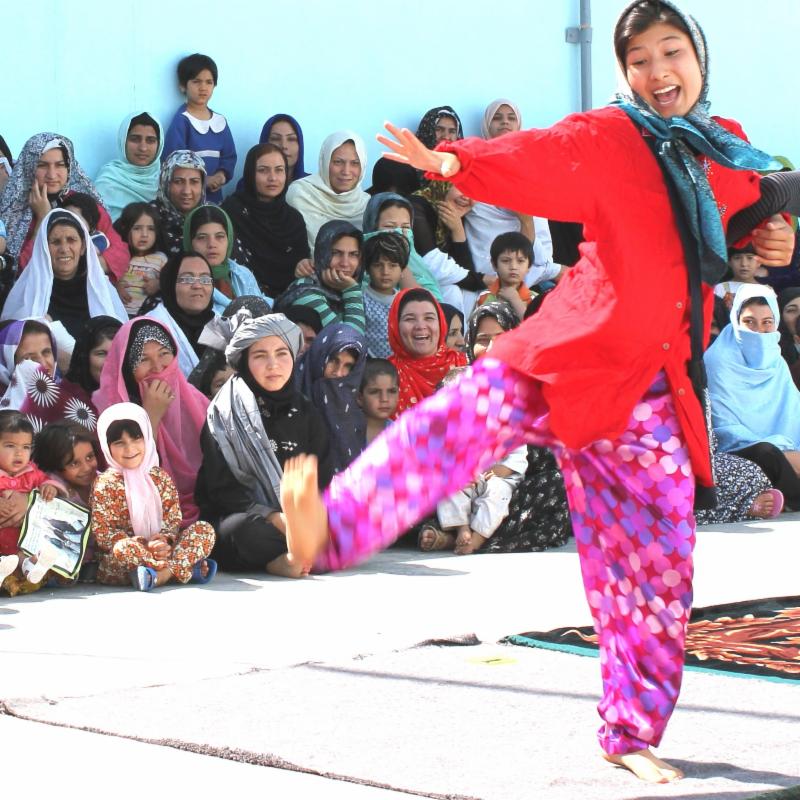
The troupe of students and actors toured Moon Cycles to five locations across the country, reaching well over a thousand people. The group even presented excerpts of the performance live on Azeri TV channel ANS TV.  After each show, we asked the audience to ask questions to characters in the play, which led to complex and insightful conversations. The actors had to respond to some challenging questions, and we observed their confidence and understanding of the material grow with each performance.

During the tour of the show, it came time to name the newly-created theatre troupe, and the name “Maybe Theatre” was suggested. Throughout the rehearsal process, the word “maybe” was used as a frequent response to suggestions. This happened often enough that it became one of the first words everyone learned in English. In a culture where learning typically does not involve open-ended questions, the name “Maybe Theatre” stuck.

The new Maybe Theatre plans to continue their work, improving and touring the show, and creating new social theatre productions. As one of the group’s members, explained: “In 21 days, we experienced things we never had before. When we entered the door into the space, we really entered a different life.”


Tuesday, May 26, 2015

Inside a Women’s Prison in Afghanistan

Our work in the Herat prison began with a performance called “Backbiters”. Now we’ve begun ongoing workshops. This post from Anna delves into the prison itself and why these women are here in the first place.


The Prison
The women’s prison is in a different compound from last time we were here. Their prior location was adjacent to the men’s prison and was needed for overflow of male prisoners. (The male prison is overcrowded with more than 3,000 inmates! The women total around 140.) It’s a good thing the women moved, as there had reportedly been problems with sexual abuse by the male guards, and now the women have their own separate location with only female guards.  The new compound also looks less like a prison. Instead of being stuck within a concrete enclosure with bars on the windows and heavy metal doors, the women can move freely between the buildings and the surrounding open space of the courtyard. Laundry hangs to dry between a few trees. The women sleep in communal dorm rooms with bunk beds, colorful blankets, and television. The women do not wear uniforms as is common in American prisons; they wear personal clothing as well as jewelry and make-up. This already makes for a more humane experience. Wearing uniforms dehumanizes individuals. From what I understand, the women can spend the day as they wish, and have available various activities supported by different NGO’s – tailoring, rugmaking, hairdressing, literacy classes, and an agricultural program where they learn to plant vegetables.

We met with the director of the women’s prison, an affable but authoritarian woman in her fifties. She told us she does not want the prison to look like a prison but instead like a dormitory with supportive activities for the women. She greatly welcomed our program.

This sounds very promising, and the conditions for the women don't seem so bad. Still, it is a prison and the women do not have their freedom. They are constrained within walls and they do not have control over their own lives. Of course, for some this may not be very different than their prior circumstances: many women in Afghanistan are not allowed to leave the house and all their activities are controlled and restricted by their husband, father, or brothers. Quite often they are beaten and abused. For some, prison must be preferable to what they endured outside it. Even so, to be in prison carries stigma, knowing you have been shamed and shunned by your community and family, stamped as a criminal and punished by society. Before you were controlled by your family, now you are controlled by the state. Your life is not your own. 

The Women
Given these difficult circumstances and with little hope for the future, many of the women have become depressed, self-harming and suicidal. One day we arrived for workshop and a woman came up to us and showed us her wrist, which had two deep burn marks. She had burned herself with a cigarette. I asked, why did you do that? She said, I was so full of angry feelings! She had wanted to see the doctor and the guard wouldn’t let her. She couldn't lash out at the guard so she lashed out at herself. Our fellow workshop leader, one of the young women from Simorgh Theatre, said she felt sick when she saw the burns and she couldn’t understand how this woman could do that to herself. But in the face of such utter lack of control and power over one’s life, this is sometimes the only way a person knows to cope and manage intense feelings and distress. This is why we are doing the workshops, to give these women an outlet in which they can express their feelings – and find more constructive and creative coping mechanisms. 

It is no wonder these women are depressed and frustrated when one learns the reasons they are  in prison. Many if not most are in prison for adultery--that is, they had sex outside marriage. This is a crime in Afghanistan. A girl falls in love with a boy; they have relations; now they are both in prison. Some women run away from home. This is not a crime per se, but it is assumed that they engaged in illicit relations. It is almost impossible for a woman to prove her innocence. Upon arrest, a woman has to submit to a virginity test, an extremely violating procedure that proves nothing. And certainly not if you happen to be a married woman. In many instances, the women have engaged in sex, but whether they were truly willing is questionable. It comes down to this: if a woman wants to leave her home, she needs the help of a man. The price for this is sex.

Why does an Afghan woman feel compelled to leave her home? Usually it's because of forced marriage and abuse. Many of the women spoke of the problem of marrying too young. As I was repeatedly told, a daughter is a toy to her father and a slave to her husband. But it does happen that she runs away for love.  A 17-year old girl in the prison ran off from home with a boy she loved, but since they now agreed to marry, they will both be released. This is one story that has a happy ending, but other girls are not so lucky. The boy no longer wants them, and now they are stuck in prison. After that, where can she go? Often the family will not accept her as she has brought "dishonor" upon them and may even threaten to kill her.

Even in the case of rape, a woman will be sent to prison for adultery. Because no one believes her. It is enough to be accused of infidelity by your husband to get locked up. Many women and girls seemed to be in prison based simply on someone’s accusation. In one case, a woman was raped by her husband’s brother, but the husband accused her of having an affair. The brother fled to Iran. The woman was sent to prison. She was pregnant but the husband said it wasn't his child and divorced her. She was released after eight months. The usual sentence for adultery is 1.5-3 years.

Some of the women are in prison for murder. They killed their husbands. No doubt for many it was a desperate act. They were married off young and abused by the husband and his whole family. But in some cases, the woman loved someone else and together they conspired to kill the husband and run away. The desperation is there but the justification is sometimes questionable.

It was challenging to learn the real reasons why the women were in prison, because, we were told, the women will often make up stories until they feel safe in speaking the truth or if they think it might benefit them in some way. But I also felt it was difficult to get accurate information from those we spoke with in prison management; they seemed too ready to dismiss the women’s circumstances. But after further discussion, they acknowledged the challenge that exists for a woman to be able to prove her innocence and how often she is in a compromised situation. The system is set up to fail these women. No matter the crime or reason, the real problem is that they have very little chance to defend themselves or escape their circumstances.

The prison psychologist shared a few particular cases with us:

·         One woman killed her husband with the help of her 14-year old son, because the father was a drug addict who tried to rape their 9-year old daughter. Now both the mother and her son are in prison. The mother was sentenced to 16 years.

·         A young woman had been beaten by her father so severely in her childhood she didn’t walk until she was six years old. As she got older her father wanted to marry her off, but she refused. She put gasoline on her father and burned him. She is sentenced to 18 years.

·         The psychologist spoke to us also about kidnapping and how entire families are swept up in the crime. A father and a brother may have conspired to kidnap someone for money. The police then raid their house and arrest everyone: the mother, the daughters, the sister-in-law, the grandmother, and everyone goes to prison. There are two young women in prison now for this crime. One was jailed at age 14 and sentenced to five years.


Here are additional stories from the women we worked with:

·         “A” has been in prison two months now. She killed her father because he was forcing the mother to have “temporary marriages” with other men (that is, sex for money). Finally the daughter couldn’t take it any longer. She took her brother’s gun and shot her father. Then she went to the police and said: “I have killed my father and I am happy I did it!” She is ashamed that he was her father, and she is proud she killed him so her mother doesn’t have to be “married” to another man again. "A" has a one month old baby with her in prison. I don’t know how long she has to stay there.

·         B is a feisty and outgoing young woman of 17 years old. She had an affair with a neighborhood boy. A couple of months later she got married, but her husband discovered she was not a virgin. So she said she had been raped. Her husband wanted to kill the other boy. But the neighbor called the national army for help and said the husband had a gun and also that he and B had stolen money. The national army came and beat up the husband so he ended up in the hospital. B had an altercation with the neighbor's daughter and cut her with a knife. Everybody was arrested, including the neighbor's daughter because she knew about the illicit relation and had not reported it, and was therefore accessory to the crime. The husband has now been released as well as the neighbor's daughter, but B and the neighbor boy were just sentenced to six months in prison for adultery. A complicated situation! B has a lot of anxiety and nervous problems. But she is very enthusiastic about the workshops and fully engaged. She’s our star participant. She even stayed up one night until one a.m. teaching the others in her room all the exercises she had learned!

·         C is in her early twenties and also very excited about our workshops and a main participant. She has been in prison for 7 months and has a 10 month old daughter. Her situation is a bit unclear. She had problems with her husband, and apparently he accused her of stealing and got her put in prison. The husband has now divorced her. She is about to be released and says her family supports her. But the first day we met she said to me that she wanted to find a family to take care of her daughter and give her an education, because if the daughter was left with her father he would marry her off early as he did her. She is so inspired by the workshops that she wants to continue doing theater when she gets out.

·         D is 27 years old. She was married at 15, but the husband became addicted to opium. He would abuse her and her child. She says her father and mother-in-law encouraged their son to beat her. They accused her of having sex with other men. She is now in prison for one year. She is worried about her 11-year old daughter who is with the in-laws; they don’t let her go to school and they beat her. The daughter comes to visit the mother every two weeks and says she’d rather stay with her in prison.

·         E is in her late forties and has a young child with disabilities. She has been active in all the programs the prison offers.  E has been in the prison 10 months and is sentenced to 16 years for killing her daughter’s husband. But she says she didn’t do it. I did not get to find out further and verify her story. Perhaps she did do it, or perhaps someone else did and she got the blame. Perhaps her daughter did it and she took the blame instead. There are several situations like this where the man died and the wife gets blamed for his death. There is little a woman can do to defend herself.

·         F is 22 and recently arrived in prison with her newborn son. She got there when her baby was 10 days old. Her husband’s second wife had died suddenly, and now she and her husband were accused of killing her by the wife’s brothers. She is in prison pending investigation and autopsy, and is hoping to be cleared.

·         Then we have G who is 19 and was working as a police officer in Kabul. One day her brother called and said, “Congratulations! Your father has found a husband for you.” But she did not want to get married, she wanted to go to the university and continue her work. The family summoned her back to Herat. She met her prospective fiancé, but did not like him – so she shot him. Just like that. Apparently, her father and brother often visit her in prison so it seems they have a good relationship. Why did she not simply ask them to please not make her marry? She said she doesn’t know, she just got so angry. She didn’t think the family would listen to her. She has now been sentenced to hanging. And yet she always seems to be in a good mood when we see her!

The women are very happy when we come but this does not mean they aren’t suffering. And sometimes they are just too depressed to participate. But we have to keep showing up for them -- the workshops are ongoing so that they will have this support available for a long term.

The Children
As mentioned, the women have their children with them in prison. Children stay with their mothers until the age of 5, when they are placed in a child support center run by a non-profit. We visited and will be doing workshops there as well. It’s a good place and the children genuinely seem well-cared for. This is really encouraging to see. They get to visit their mothers every two weeks or so. The smaller kids who are with the mothers in the prison get sent to a kindergarten every day, where government employees’ children go. This is also a new development and did not exist four years ago when we last visited, as far as I know. It’s really good that the children can be with their mothers, but it is important that they are not stuck inside the prison all the time and can socialize with other kids. There are about 75 children living with their mothers in the prison. One girl was seven years old, but otherwise mostly toddlers and babies. We had several crawling around us as we did our workshop. The women are help each other take care of the babies, so the mothers can participate. 

Stay posted for further updates about the juvenile center and our other performances!

Tuesday, February 17, 2015

First Impressions of Afghanistan and the Creativity in Action Program

Heddy Lahmann-Rosen, a Bond Street company member, just returned from her first visit to Afghanistan with Michael and Joanna for our new, two-year Creativity in Action program. Heddy will visit Afghanistan a handful of times during the course of the program, acting as our Outside Evaluator, and eventually using this research in her PhD thesis. 


I'm a little late to the party on getting a blog entry going for my time with the Creativity in Action program in Afghanistan, but I'll do my best to give a flavor of the whole experience. 

I embarked upon the adventure to Kabul with Michael and Joanna in mid-January, and I stayed for 2 weeks. Joanna and Michael are still there working away at building this program and making sure it's got the wings to keep flying when they come back.

My first week primarily consisted of a good amount of administrative work and preparation for this big and ambitious program. This baby is no small feat! The Creativity in Action program is 2-year youth development project that includes 15 young people from each of 25 provinces across Afghanistan (375 youth in all!). The program is providing jobs for local Afghan artists to work with youth– teaching them about expressing themselves and accessing their creativity, and then mentoring them and supporting them as they create and implement improvement projects in their own communities. If you can't tell, I'm pretty excited about it. So excited in fact that I'm centering my (eventual) dissertation around this phenomenal program!

So what's Kabul like? That’s kind of a tough question to answer, because I didn't really see so much of the outside world except through the car window. What did I see out the window? Well, Kabul is less conservative than other parts of the country. Some women wear burqa’s, although there are very few women on the streets anyway. I’d say it’s like 90% men. Unpaved roads for the most part. The air outside smells smoky from the ovens they use to warm homes. It’s winter and pretty cold – ranging from around 35 degrees F to 50. The heating isn't what we’re used to in the US, so lots of layers are necessary. It even snowed a few days while I was there!

The driving in Kabul is really something. It’s positively fearless (except for a Western passenger like me) – I mean, we navigated through the most insane tangle of cars on the way home one night– I thought we might be in serious trouble and stuck there for awhile (because if we were in the US, we would have) – but somehow our driver just wriggled, honked, and near-missed his way through. It was something to behold. 

The food is awesome! Maybe with the exception of breakfast, but that’s just because they don’t really do breakfast like we do. But everything else was AMAZING. Flower street, which had several florists up and down the street, was very pretty! Butcher street is not so pretty, as you might imagine.

The Afghan people I had the opportunity to meet are lovely. Very kind and warm. I met and spent some time with the Afghan artists who are/will be leading the youth workshops and are long time friends and creative partners of BST. They were all so eager to share their thoughts and experiences with such openness and enthusiasm. It was a major highlight!

I also had the opportunity to see some of the youth workshops in action in the Balkh region. I had such a wonderful time  meeting and getting to know the youth participating. They're a very inspirational group. They were incredibly warm and welcoming and had many questions about my doctoral program and my experience of being in their country. They are all very concerned and passionate about the state of their community and country and are eager to talk about the problems they see and ideas for ways to go about addressing them. I was pretty floored by how engaged they were with the whole process from the get-go. After I left, the youths from Balkh and Kunar met in Kabul for a combined workshop. This program provides a unique opportunity for connecting young passionate problem-solvers from across the country and across ethnic divides. It's killing me to have missed the Kabul workshop! But alas, my spring semester classes beckoned me back. I've been living vicariously through email updates from Joanna on the collective workshop with the 2 groups in Kabul- I will let her tell it- from what I read, the experience is something truly special.

I'm already looking forward to my return!


Thursday, February 12, 2015

Youth from across Afghanistan collaborate in Kabul

Joanna keep us up-to-date about the goings-on in Kabul. Afghan Project Leaders have completed workshops in Balkh and Kunar, and now youth from both groups are in Kabul together for a week of workshops, training, and idea-sharing.
Joanna Reports:

This morning the participants were all happily doing warm-ups and exercises. Now they are creating their "community mapping" (drawing their region) and then their "ideal communities" (as mixed Kunar-Balkh groups, hopefully sharing their ideas about what makes an "ideal" community).  

The sounds of laughter fill the house as it should be.  

They did their "community profiles" last night.  Very interesting -- each presentation was really really well done!  The issues that rise to the top are environment, medical, and women's rights.  The Balkh girls were all about pre-marriage testing to prevent certain diseases, and the need for vaccinations.  Both the Balkh and Kunar guys were most concerned by the wanton cutting of trees, soil erosion and proliferation of trash.  And the Kunar girls showed some shocking photos of the violence against women, including trading girls for bad debts, and blaming women for the crimes of others.  Unbelievable!  

We worked with the girls all together this morning and the Kunar girls are ready to speak out... but still cover up the second a male or a camera is anywhere close.  Three are daughters of other active women, and the other two need some gentle coaxing... but that's okay.  They will all help each other I hope.  

And then, two days later…

The workshops are continuing well! It is super-busy and also super-fun.  

We have had some great guests speaking about youth activism, how to meet challenges, how to get the government to listen, etc.  And today we went to the Presidential Palace!  It was grand... and an amazing experience for the youth -- like a trip to the White House to meet ... well, okay, not Obama... but maybe Joe Biden.  


We had a two-hour session with one of the top people during which the participants stood up and talked about their issues. Wow.  Can you imagine getting a chance to air all your grievances with some top government person who is actually listening and writing it all down. Even the Kunar girls all covered up stood up and gave their rant.  The guy was very moved, and then he told us that he had also had this idea to set up creative youth projects in different provinces, then bringing the groups together and implementing the projects.  So he was very happy that we were doing just that.  

This Balkh-Kunar collaboration is the first of many in the coming years. Groups from across Afghanistan will come to Kabul and share ideas with group members from a different province, each with their own issues, solutions, history, and culture. Stay posted for more updates from the field! 

Wednesday, January 28, 2015

Theatre for Social Change Successes and Challenges from Kakamega, Kenya

Our Fall 2014 intern, Jessy Hodder, is spending the semester in Kakamega, Kenya where she is conducting physical theatre workshops with various groups, from sex workers to street boys. She has been testing out our new theatre for Social Development manual. Here, she describes some of the challenges and successes of a recent training session with sex workers.

I had a very positive meeting this morning with Kakamega's sex workers.  

The first thing that I should note is that, like many places around the world, things are far more challenging than you expect them to be.  Things don't start on time, and the people are not used to open, unstructured spaces.  It took the women some time to get comfortable in a space without desks and chairs.  Having a translator also presented some real challenges.  I was never sure if what I was explaining was being fully understood by all participants.  Things can so easily get lost in translation.  I think that it may be helpful to include notes concerning these kinds of logistics (tips or tricks to help facilitators overcome such difficulties) within the manual. 

Below is a list of the activities that I facilitated and some of the observations that I made.


Spy:  Secret Friends & Enemies

At the beginning of this exercise, the women protested profusely.  They hated the idea that they had to select an "enemy" in the group.  I tried to explain that it was just for the sake of the activity, but they wouldn't have it.  So we changed it to person A and person B:  "Keep person A between you and person B."  I thought this was interesting.  It definitely reinforces the sense of community that is so ingrained here, and indeed the sisterhood of those who suffer on the streets.

Also, the fact that Kenyan women are such touchy-feely people posed a problem.  When I said "go," the women ran to the person that they had chosen as their "friend" (person A) and just stood there hugging them and laughing.  They had completely forgotten about the "enemy" (person B).  They were so loving and supportive that they got caught up in cuddles and disregarded the activity itself.  Because of this, we may want to suggest that, in certain cultural contexts, participants can never touch their friend OR enemy, ensuring that some kind of physical activity takes place.


Calling Over the Mountain 

I explained the importance of our names, especially in contexts where we feel treated like objects.  The women had absolutely no difficulty shouting their names.  They were very loud, and they loved it!  

I added a little something extra to this activity which I thought worked well.  I asked them to imagine that they were standing on a stage in front of the world.  I asked what they would want to say if they were given a single sentence.  They were all eager to share.  Some of them declared their strength or beauty, others testified to their faith or beliefs, and others shouted funny exclamations.  The voices of these women are not often heard, and they loved being able to speak loudly and with conviction. 


Making Group Shapes and Scenes . . . with a Time Limit!

Participants worked in groups of five.  I focused on items that they are very familiar with - the jiko (outdoor stove), nyumbani (house), matatu (bus), and a sofa set.  They really enjoyed using their bodies to represent these items, and they worked well in their teams.  However, because of the stigma against trousers here, the women struggled a little bit with moving around in their long skirts.  I know that this is a challenge in many different areas of the world, but it was definitely something that affected their movement.


A Commercial - Selling Something New

This activity was particularly interesting to me.  I will begin by saying that Kenyans are wonderful public speakers - they have little or no fear of addressing a group.  In fact, they love doing it whenever they get the chance. 

I had tried very hard to explain the word "invention" - an object that doesn't yet exist that would make one's life easier or better.  However, either the word got botched in translation, or the culture is such that they don't think in terms of new objects and gadgets.  Technology is not nearly as prominent here as it is in other places.  Their mindsets are also extremely practical, and they are desperate to make any money that they can to support their children, particularly in terms of school fees.  

When they presented their inventions to the group, almost all of the "inventions" were in the form of possible businesses (basket making, embroidery, selling maize, etc.) that they could set up in the community.  While this was not expected, it attests to their deep desire to become self-sufficient.  We spoke for a while about where they might get the capital to start one of these businesses.  This, of course, is one of their greatest challenges, but we are looking for ways of helping them.


Image Theatre or "Photographs" 

In groups of five, the participants were asked to think of a time when they experienced sadness.  Some of the groups became emotional when telling their stories, and it was great to see the groups counselling and loving one another.  Each story was presented either as an image or as a scene.  The audience was then asked to advise the woman on how to fix or change the situation.  I did not feel that they were ready for foruming the scenes this time around, so they just spoke from their seats.

The stories included:
- A woman was thrown out of her house by her husband.
- The living space of one woman had been thrashed by her landlord.
- One of their children took her school fees and blew it on alcohol and other frivolous items in town.

Unfortunately, we had to stop this activity short.  Two men had entered the room on business, and the women were uncomfortable sharing with them in earshot. 

I concluded the workshop with a self-defense lesson and discussion (30 minutes).  At this point, their bodies were warm and more able to move.  We spoke about precautions that they can take when they are walking along the road at night, and how they might defend themselves if attacked from the front, from the side, and from the back.  They seemed to really appreciate this kind of training.

We sang a good African tune and shared lunch together.  It was a successful session! 

Thursday, September 26, 2013

Afghan Women Speak Out through Theatre

Extra, extra, read all about it!


Bond Street Theatre 

Afghan Women Speak Out through Theatre

We have launched an Indiegogo campaign to support Afghan Women's Voting Rights in preparation for the April 5, 2014 elections, and you can make a huge difference!


This is a time of hope and possibility.  A new generation is voting for the first time in Afghanistan, and half of them are women.  Women's right to vote is a hard-earned victory, and yet many women are unaware of their right to vote.  

This is a time for crucial change.  In the past decade, women have made great strides, setting Afghanistan on a promising course. But conservative factions are working hard to reverse these advances and prevent women from enjoying the most basic human rights.  

The time is now to stand with the women of Afghanistan.  We are asking for your support to help our all-women's theatre troupes bring vital information to women who are isolated by tradition, location or incarceration. Your contribution goes directly to the women's groups!  To reach women across the country,  

Women's voice in government and participation in the election is essential to protect and advance their rights! 

"This theatre project has given me new courage to speak out!"
  (Ayesha, member of Nangarhar Women's Theatre troupe in Jalalabad.) 


Bond Street Theatre
 has been working for Afghan women for more than 10 years.  We trained four women's theatre groups to create theatre -- by women, for women -- to spread the word about women's right to vote, why each vote counts, and how to register. They are a first in Afghanistan! 

These women are role models: they encourage women and girls to speak out. Theatre shows like these have a ripple effect through the community and a huge impact. 

In order to reach as many women (and men) as possible, we must raise $10,000.
   
 Visit our Indiegogo page Afghan Women Speak Out through Theatre to contribute! 

Please spread the word via email, Facebook, Twitter or actual face-to-face interaction!

Thank you for your support!   
The Bond Street Team and the Afghan Women's Theatres


ClosingBond Street Theatre
Blue Like us on Facebook Follow us on Twitter View our videos on YouTube Visit our blog 

Bond Street Theatre initiates theatre-based projects for education, conflict resolution, and healing in areas of conflict and poverty globally.  Bond Street Theatre is a not-for-profit 501(c)(3) organization, and NGO in association with the UN-DPI.   
Please support our campaign for Afghan women:
Bond Street Theatre
2 Bond Street, New York, New York 10012   --  212-254-4614  --   info@bondst.org     www.bondst.org

Monday, September 09, 2013

Intern Spotlight: Aly Trombitas

Here is our final intern spotlight!  Aly shares how BST aligns with her aspirations to make art and help people:

From when you can talk onward, there’s always that one question you’re consistently asked: What do you want to be when you grow up? As a highly optimistic college student with too many interests to count, I’ve always hesitated before responding to that question, because “Make art and help people” isn’t a satisfactory answer for most.

I discovered Bond Street Theatre’s website while doing research for a class, and am pretty sure I applied for an internship within the hour. Here was a group of trained physical theater artists who were using their craft not only to create compelling performance but also to promote human rights internationally—it sounded like a win/win situation to me!  I had been looking to spend my summer somewhere where I could get a sense of many aspects of a small theatre organization, instead of being guided into only one particular skill. Bond Street spends time with each intern to allow you to explore and grow, and that’s exactly what I needed. Not only is the office open and airy (and no shoes allowed—a valuable perk in my opinion) but it carries 37 years of not-for-profit arts and humanitarian knowledge. Even after 2 ½ months of taking everything in I am still in awe of the travels and impact that Bond Street has had in the world (75,000 refugees reached in Kosovo? Wow!)  

My summer at Bond Street has been incredibly fulfilling and inspiring. I’ve gotten to know an amusing company of theatre professionals who are so wonderful at looking beyond themselves to a broader world. I’ve become much more aware of myself as a part of that world—in one day I could be scouring news sites to provide updates and information to the Haiti team, researching grants for women’s public speaking programs in Afghanistan, talking with the Syrian-American Council about working with refugees, and editing the study guide for our new Young Audience Program. I’ve always been a team player, but I’ve never been a part of such a big team before! Many incredible people in many walks of life come together to make Bond Street’s vision a reality, and I’ve really been impressed at the interdisciplinary communication that makes programs as effective as they are.

Bond Street also values their interns as performers as well as administrators—I got to try my hand at solo and partner acrobatics and, of course, stilt walking. Stilts were certainly scary at first! But I was very proud of myself when I was able to let go of Katherine and Anna’s hands and walk around on my own. I can’t imagine how incredibly empowering that feeling must be to people around the world living in oppressive conditions, tall and strong and balanced on stilts—to me it epitomizes what Bond Street is trying to do.


This has been a wonderful place to spend my time. There’s been a lot of learning, big laughs, and some high quality iced coffee. Being here has further prompted my determination to make an impact in the world and I feel more confident than ever that “make art and help people” is a worthy pursuit. 

Friday, August 30, 2013

Afghanistan: New Courage to Get Out the Vote thru Theatre

An update from the field from Olivia :

Hello from sunny - actually, a bit rainy today - Kabul, where we just finished a week of pre-program training workshops for the Voter Education and Fraud Mitigation Project. Every morning this week from 8-12:30, we have been leading workshops for 2 members of the Nangarhar team, 2 members of the Kandahar team, and 8 members of the Kabul team in the tools necessary to implement this project from now until the elections next April.

The project has many parts: 1) a series of educational and mobile performances to spread crucial election information to Afghan citizens and engage them in community dialogue about the issues that matter to them in the presidential elections; 2) Leadership Workshops for youth that engage young people (16-22 ish) in discussion about why voting is important and the value of democracy; and 3) engaging election officials and independent monitors as allies to share information and findings.  Because of all these moving pieces, this week of workshops went by like a flash trying to communicate all the necessary information!

Before I arrived, Michael and Joanna had a series of meetings in Kabul with the Independent Election Commission, Ministers, and others to let them know about this project. They are excited about the project’s potential, and we have partnered with the IEC in the 4 provinces where the teams are performing.  That is good news for the local teams, who have access to more voting information through this partnership.

The workshops focused on the content of the shows, the post-performance activities, the evaluation measures for the project, and the curriculum for the Leadership Workshops. I can hardly believe that the week is over and I am writing about this in the past tense!  We worked quickly this week, but it hardly feels like work to be in a room full of people who are all getting the chance to do what they love for a good cause.

On the first day of the workshop, we had a discussion about why theatre may be a good medium to spread this information. The IEC and other groups have television messages and radio dramas that promote the elections. As our partners said, not everyone has access to TV and radio all the time - and both TV and radio can be switched off. Having a real, live person performing in front of you creates a direct and emotional relationship, one that is more likely to lead to a change in action.

The post-performance dialogues will also help in that regard. The dialogues are inspired by Theatre of the Oppressed techniques, and ask the audience to come up with alternate solutions to the issues presented on stage. In addition to thinking of solutions, audience members are encouraged to take the stage themselves to try their ideas with the actors. This technique allows audiences to make action plans, and to engage in community discussion about issues that may not come up in everyday life.

Every day, we spent some time discussing common voting issues and using those discussions to make pieces of theatre. What struck me was that many of the issues identified in Afghan culture are common issues in American elections as well - folks who do not believe that one vote matters and do not trust the democratic system, and so choose not to vote at all.  That’s common everywhere that elections are held, I think, so we spent lots of time discussion potential solutions. First and foremost, people need to have confidence in the election system to believe that their ballot will make a difference - so the performances that the troupes are creating for this project will all promote that confidence.

Using Image Theater, narration, and improvisation, the participants made and performed short pieces addressing those issues and many more. They took on women’s right to vote and those who believe  women shouldn’t vote, the lack of voting infrastructure that causes long lines and too few ballots, bribery and threats from candidates, access to the polls for folks living with disabilities (which turned into a discussion about the larger responsibility of all Afghans to ensure all can participate in the elections), and the value of one vote.  

Now that they have a lot of content, the troupes are going home to finalize scripts that merge some of the stories and issues. Once the scripts are done and rehearsed, each troupe will perform over 50 shows before April. The Kabul team is travelling to Bamyan and Kunduz to perform, rather than staying in Kabul where the IEC has a strong voter education program.  They will also conduct the Leadership Workshops for youth in those provinces, which includes a mock campaign to illustrate some of the common joys and issues with the elections.

As the troupes begin to perform in August, we will have more information about the impact of these performances and the experiences that our partners are having in the field. Right now, we are proud and tired, and excited for what this project has in store.

This project is my first time in the country, and I have thoroughly enjoyed myself. Though our partners tell me I look Afghan, I know I still stick out a bit. All the folks I have met here are warm, welcoming, and thankful, in addition to being the best hosts around.  Even though it is Ramadan and our partners are fasting, they are all focused and dedicated on the work at hand (not to mention talented). I cannot wait to hear the stories of their successes, and to return to work with them again.

Ayesha

Ayesha is studying biology in University, and teaches human rights workshops for women all over Nangarhar province. But it took me almost a week to find out all that information. Ayesha is also the director of the women’s troupe of the Nangarhar Theatre, one of our partners for the Voter Education and Fraud Mitigation Project.  I met her in Kabul, where she came with the director of the men’s troupe for a week of training and program set-up.

When I met Ayesha, she was shy, giggly, and self-conscious. Jalalabad is a more conservative area than Kabul, and she dresses in long black garments over her other clothing all the time. She would not make eye contact with Michael, and she was decidedly uncomfortable in our daily theatre warm-ups. She had never done theatre before - but she had certainly taught workshops.

Ayesha, like all Afghans, is a perfect host. She invited us into her room for melon nearly every night, and it is those conversations that made her begin to open up. We learned about her work with the women and her life in Jalalabad.  Since she was staying in the same hotel that we were, it was easy to have these after-dinner chats, particularly since she was fasting and much happier after her dinner.  It was during the first of these conversations that she told us that this workshop is giving her new courage.

Little by little over the week, Ayesha began to open up and come out of her shell.  We learned that she has quite a silly side and loves to joke around. She also gave me the best nickname I have ever had - ILoveYou, which is what my name sounds like to her.